12.01.2020
Story by Petty Officer 1st Class Chelsea Milburn
Commander, Naval Air Force Reserve
Most within the Navy have heard the phrase, “Every Marine is a rifleman; every Sailor is a firefighter.” In a branch of service with mission sets that have inherent fire danger, it’s essential that the Navy has experts prepared to fight fires that may threaten equipment and personnel.
While no Sailor has firefighting as their sole profession — even damage controlmen have firefighting as just one of their several skill sets — starting from day one at recruit training, Sailors across the fleet are trained in firefighting, regardless of their primary job function. When that inherent fire danger is paired with being located in a fire-prone region like Southern California, this role becomes even more important.
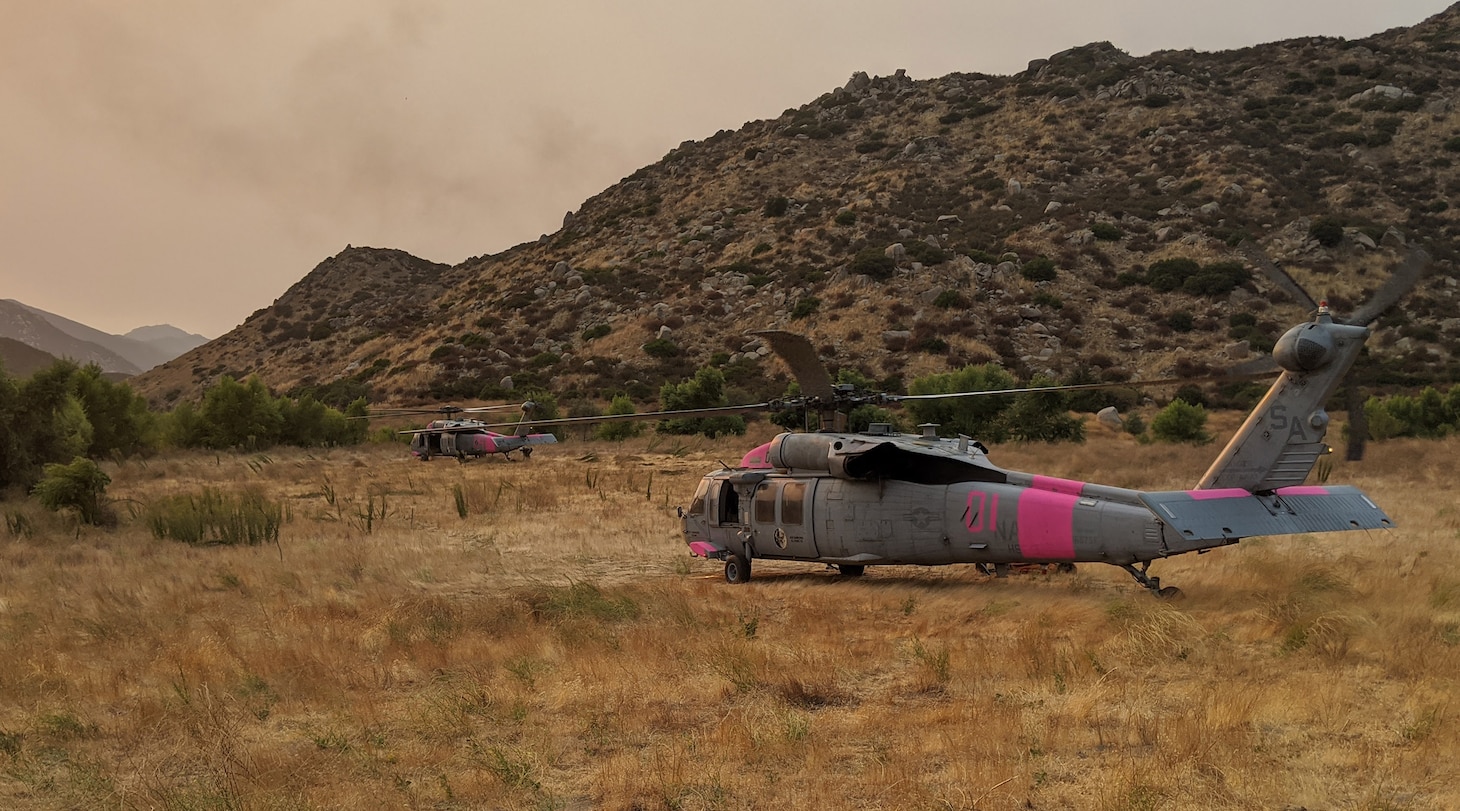
The “Merlins” of Helicopter Sea Combat Squadron (HSC) 3’s Southern California Offshore Range (SCORE) Detachment is a Naval Air Force Reserve detachment that takes this essential firefighting proficiency to the air, supporting naval installations and assisting civilian fire agencies in an emergency when state resources are spread thin. The detachment consists of eight Full-Time Support (FTS) and eight Selected Reserve (SELRES) pilots, 45-50 FTS maintainers, eight active-duty and eight SELRES aircrew. Their primary mission is to provide range support on San Clemente Island, most often supporting anti-submarine warfare (ASW) training.
“I think the best thing about being assigned to SCORE Detachment is how much we get to go out and do the missions we train for,” said Naval Aircrewman Helicopter 2nd Class Zachary Romero, who served with the detachment on active duty from 2012-2018 and continues his service with them as a Selected Reservist. “Other H-60 units spend most of their time training. At SCORE, we practice and then we get to regularly put what we practiced into action. There’s no better feeling than that.”
“In general, we facilitate about 50% of the ASW readiness for the aircraft, destroyers and submarines that come from west coast squadrons” said Lt. Cmdr. Zach West, the detachment’s officer in charge. “We’re out on the island from one or two days to a full week just about every week with two aircraft providing range support.”
While SCORE Detachment primarily supports the range through the launch and/or recovery of underwater and aerial drone targets, West described how firefighting fits into their role supporting San Clemente range operations.
“Firefighting has always been a contingency mission for us,” explained West. “There is a firefighting requirement for San Clemente Island to support their live-fire range for small arms, missiles, etc. Ranges need firefighting capability if they have a live impact area.”
West also detailed how SCORE Detachment is uniquely positioned to be able to quickly respond to a fire.
“We are a sea-going command with the personnel and manning to support the quick spin up and turn around to support firefighting while also being here in Southern California year-round as our operations take place in San Clemente,” he explained. “We also have a high amount of collective experience with firefighting here as we have some longstanding Selected Reserve pilots who have been with us as many as eight years.”
This unique position led the detachment to become the firefighting program managers for the local Helicopter Sea Combat Wing Pacific squadrons and to develop a close relationship with the California Department of Forestry and Fire Protection (CAL FIRE) after working closely with them for 17 years.
“With the devastating fires we had in 2003, the Navy and Marine Corps were willing to help us but were unable to because they didn’t have civilian radios to communicate or the correct training or procedures in place to operate in that civilian air space,” said Tony Mecham, dual-hatted fire chief for both CAL FIRE San Diego and San Diego County Fire.
“That was when that relationship with CAL FIRE started,” said West. “[The “Firehawks” of HSC-85], who we were assigned to at the time, developed a joint ground training program with CAL FIRE. The squadron provided the aircraft-familiar egress training, and coordinated aviation water survival training for CAL FIRE military helicopter coordinators, who now fly with us when we fight a fire.”
Mecham went on to detail the value of the relationship with the Navy and Marine Corps in the stress of increasingly dangerous fire seasons.
“Every year, we think we have the worst fire danger conditions of all time, and then each year it gets worse,” explained Mecham. “The fire danger here often comes from the Santa Ana winds, which blow generally from North to South. We’ll see fires happen up in the Los Angeles area first, for example, and send resources. Then the following day, we have fires down here while some of our resources are still up North. Having this partnership to support the region is a really comforting thing for us, knowing that in an emergency we have that backup.”
Mecham added that his high level of confidence in SCORE Detachment pilots and those from other Navy and Marine Corps squadrons was born from his experience working with them and seeing their capability.
“The Navy and Marine Corps have incredibly talented pilots, and we love working with them,” said Mecham. “All we had to do was give them a little additional firefighting training, and then we let them do what they do best.”
Through this partnership, SCORE Detachment has provided assistance for the Horse Fire in 2006, the Witch Peak Fire and the Harris Fire in 2007, the Basin Complex Fire in 2008, the Vallecito Lightning Complex Fires in 2012, the Springs Fire in 2013, the Lilac Fire in 2017, the Thomas Fire in 2018, and the Valley Fire in September 2020.
“Like so many tactical missions in the Navy, firefighting is really about the troops on the ground, in this case, the firefighters,” said West. “Those firefighters do incredibly hard work in really unforgiving environments. It really is an honor to be able to go out there and support them and protect the region.”
Having annual training and an established relationship with experts at CAL FIRE helps SCORE Detachment do just that, not only for supporting the region in emergencies with wildfires, but for being ready to fight fires on Navy installations.
“Supporting firefighting efforts from the air is a simple mission that has a lot of complex details,” said West. “At the end of the day, all you’re really trying to do is get water on the fire and put the fire out. But after taking into consideration the people on the ground, obstacles that may be hidden by smoke, the high-altitude and high-temperature environments that affect the performance of the aircraft, heavy aircraft loads from carrying the water, and winds that are sometimes unpredictable — it can quickly become very challenging. It’s important to have established proficiency and experience, so we can operate safely.”
In 2018, SCORE Detachment was quickly dispatched and on standby for the Woolsey fire when it threatened Naval Air Station Point Mugu. Most recently, the detachment supported Sailors and federal firefighters working to contain the fire on the Wasp-class amphibious assault ship USS Bonhomme Richard (LHD-6) at Naval Base San Diego.
For Romero, being a part of supporting the crew of Bonhomme Richard was a moving experience for him as a Sailor. “When you’ve been on a ship, you know that a lot of people have strong emotional ties to that ship,” said Romero. “When the crew is fighting the fire and working to save their ship, it’s a really powerful thing to know that you’re there alongside them.”
West explained how SCORE Detachment’s longstanding partnership and rapport with CAL FIRE helped them be prepared to provide that support.
“When we were notified we’d be supporting the firefighting efforts aboard USS Bonhomme Richard, I was able to call one of our contacts at CAL FIRE and ask for their expertise,” said West. “We’re always grateful to have those connections to be able to get their insight.”
In addition to protecting the region and Department of Defense assets, having Reserve personnel able to respond to these emergencies, maintain this proficiency, and help train and qualify active-duty pilots and aircrew is also beneficial to the Navy as a whole in another crucial way.
“SCORE Detachment taking on the role as firefighting program manager has one important thing in common with the mission we carry out day to day,” said West. “Both augmenting the wing’s aerial firefighting capability and supporting range operations on San Clemente Island are roles that have allowed us to take some of the burden from our active-duty counterparts, so they can focus on warfighting. Firefighting is another way that we’re able to provide that support.”
While the unit as a whole helps to take some of the weight off of local, active-duty squadrons, their Selected Reservists also have a role in reducing operational stress from the detachment’s active duty and FTS personnel.
“The active and FTS Sailors are always there ready to go, but they’ll call the SELRES as well for additional support,” said Romero. “Firefighting is a really taxing mission, so having us available to fill in when they need to rotate out can make a big difference.”
Romero isn’t just aware of the difference the work he and his SELRES peers makes for their full-time counterparts. Recently, he gained a new, personal perspective on the impact of firefighting efforts in the region.
“Around the same time I was notified we were being called in for the Valley Fire, I also got a warning text message that my neighborhood might be evacuated,” said Romero. “I could see the smoke coming up just over a hill from my house. At that point, it wasn’t just the homes of people I didn’t know, it was my home and my neighbors’ homes. In that situation, it just becomes so much more real. You know when you’re making drops on that fire just how much every drop counts. When people are being evacuated and homes are being lost, all you want to do is be able to do something to help. This is a way for us to help make a difference.”
HSC-3 “SCORE” Detachment is a Naval Reserve detachment under Commander, Naval Air Force Reserve (CNAFR). CNAFR mans, trains and equips the Naval Air Force Reserve in order to provide enduring operational support and strategic depth to Naval forces that win in combat.


