Story by Staff Sgt. Danielle Sukhlall November 17, 2023 at 01:38PM EIELSON AIR FORCE BASE, Alaska – As a 911 dispatcher, you need to be prepared for any situation because one day you may receive a call that requires you to make a difference. Senior Airman Desimond Thomas, 354th Civil Engineer Squadron firefighter, received that call and saved an infant’s life October 19, 2023, at Eielson Air Force Base, Alaska.
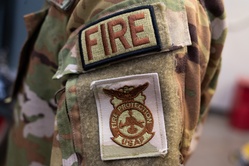
EIELSON AIR FORCE BASE, Alaska – As a 911 dispatcher, you need to be prepared for any situation because one day you may receive a call that requires you to make a difference. Senior Airman Desimond Thomas, 354th Civil Engineer Squadron firefighter, received that call and saved an infant’s life October 19, 2023, at Eielson Air Force Base, Alaska.
On SrA Thomas’s last day as a dispatcher, he received a call at 5:45 p.m. from a distressed mother whose infant was choking on formula. At the time, Thomas was the only dispatcher on duty.
“All 911 calls are different. When we got the call, she was panicking, telling us to ‘just get there’,” Thomas explained. “I had to calm her down to try and get the information we needed.”
In life-or-death situations like this, it’s important for dispatchers to get information from the caller to figure out their location and situation to send the proper aid. Getting this information is critical to send help as soon as possible.
“In situations like these, you have to treat these 911 calls systematically,” Tech Sgt. Christopher Johnson, 354th CES fire emergency services, emergency communications section chief explains. “You have to look at it as getting four main pieces of information so you can send crews. These four components of information are the caller’s location, a callback number, their name and emergency situation. During the incident, she struggled to communicate the information, however SrA Thomas’s calm approach allowed him to quickly get the necessary information and dispatch crews.”
After the first responders were notified, Thomas stayed on the phone with the mother and coached her through performing back blows on the infant to clear the infant’s airway to avoid cardiopulmonary resuscitation. After crews are dispatched, and dispatchers have collected all the information, there’s time gap that the caller has on the phone with the dispatcher.
“When I’m dispatching, I'm just trying to do everything I can,” Thomas said. “We don't have lists to tell a person what do beyond notifying the appropriate agencies to respond and help, so I was going off my head from what we had learned in training, to pass on to her.”
Every year the 354th Civil Engineer squadron fire and emergency services typically dispatch an average of 500 emergency calls annually that can range from in-flight emergencies, ground emergencies, hazmat responses, emergency medical, and mutual aid calls. To prepare for these situations, the 354th fire and emergency services personnel must be certified in both Public Safety Telecommunicator I and II. In addition to this training, the emergency communications dispatchers also go through local certifications and additional training requirements.
“During their two weeks of dispatcher training, we try to put them through a variety of scenarios that require critical thinking,” Johnson explains. “However, you can't recreate every emergency that's ever going to happen, so our goal is to set them up for success so they can manage any emergency the base could experience since each call is different and no one is going to respond the same to any one type of call.”
In the end, SrA Thomas’s instructions allowed the mother to successfully clear the infant’s airway before the first responding crews arrived. “After I got off the phone with the mother, I still felt like the infant’s care was in my hands and wondered if I had provided the best information or guidance,” Thomas explained. “I felt a huge sense of relief when our guys came on the radio and said the baby was breathing again.”
Situations like this show how important the proper training can be. Johnson said he didn’t realize how much training you retain until you’re pushed to perform.
“This is not a job meant for everyone and can be hard to process and mentally prepare for,” Thomas stated. “Whether that’s answering calls or responding to them-it’s a very demanding job and I’m proud of every Firefighter out there whether they’re civilian or military.”