http://dlvr.it/T0bfLp


What’s the context?
Unions say a new law to boost firefighter staffing on military bases is key to public safety and staff well-being
Clock ticks down on Defense Department
New law follows Context report
Firefighters report persistent safety, morale issues
RICHMOND, Virginia - The United States is racing to meet new minimum firefighter staffing levels at its military bases ahead of a Dec. 23 deadline aimed at ensuring stations can protect the nation's defenses while keeping firefighters safe, too.
With time ticking down on the Department of Defense (DoD) to act, unions say the federal government is dragging its feet and that lives and property are at risk due to the understaffing.
The military says the new law could significantly impact its operations - its potential workarounds include shutting stations or cancelling leave - while those on the ground predict it might simply blow through the deadline in violation of the new law.
"Any time there's a requirement leveraged on (DoD) fire protection, it's the end of the world for them," said James Johnson of the International Association of Fire Fighters union.
"Of course, they're screaming foul because they're going to need additional money, according to them."
Firefighters say chronic staff shortages are putting lives at risk, exacerbating the heavy mental strain of a high-risk job even as many struggle to make ends meet at home on DoD pay.
Polls show firefighters suffer high rates of stress, negative health impacts, and suicidal thoughts compared to the general population.
For its part, the military says it is working to meet the new mandate, handing responsibility to its fire chiefs and commanders in the field to think creatively so as to meet the new federal target.
"These leaders are best positioned to identify the most effective means of managing and mitigating their locally-identified risks," said U.S. Army spokesperson Matt Ahearn.
The U.S. Navy, Air Force, and Marine Corps are likewise working to comply with the new law, according to spokespeople for the branches. The new language does not apply to the Coast Guard, according to a spokesperson.
Frontline staff question what has taken their bosses so long, saying other DoD fighters wouldn't get the same treatment.
"They're not going to fly a helicopter with only one pilot and only one crewman in the back. They're going to staff it completely. Why don't they want to do that for us?" asked Mike Jackson, a firefighter at Joint Base Myer-Henderson Hall, an Army base just outside the capital.
Firefighters say their needs are often marginalized, even as demands grow. Escalating climate risks are already putting a strain on wildland firefighting forces – and those working the bases say they face added peril due to chronic staff shortages.
Further strain?
The new staffing number mandates were signed into law after Context reported that a soldier at Joint Base Myer-Henderson Hall had died amid broader concerns about staffing levels.
Jackson said the new law was "absolutely a step in the right direction. It's a safety thing."
While some bases have been running vehicles with sufficient staff for some time, Jackson said that was not the case everywhere.
A firefighter at a base in Florida said low staffing levels pose serious risks – and would eventually come to a head given their key role protecting the nation's military.
"Eventually it's going to kill somebody, whether it be a fireman or whether it be a military person or their family," said the firefighter, who spoke on condition of anonymity.
"It's crazy, man. It's scary. It's scary to drive into work ... it's not a matter of if, it's a matter of when."
Another firefighter who works at a base in the southeastern United States said people were nearing a breaking point.
"It's a constant strain not only mentally (and) physically, but emotionally - personal lives, home life. When you go home, you're all stressed out about work," said the firefighter, who likewise spoke on condition of anonymity.
The military has come up with potential options to meet the new law, be it shutting stations, adjusting overtime or cancelling leave.
But the "prescriptive language" in the new law "will further strain" fire and emergency services departments, according to Army guidance seen by Context.
"Some measures ... are reasonably tolerated, while others are significant and may lead to major issues," it says.
The Army has issued guidance based on "national consensus standards," said Ahearn, the Army spokesperson.
"This approach evaluates the level of risk against community response standards, mission readiness, performance objectives and prevention measures," Ahearn said.
The firefighter union's Johnson said they had to pursue legislation because the military was not going to act of its own accord.
The push was based in part on research from the National Institute of Standards and Technology (NIST) showing the difference even a small number of extra personnel can make.
"Our pursuit was for the safety of the firefighters, but also the ability to do the job," he said. "There's nothing worse than (showing) up on scene and not having the resources."
He predicted some "growing pains" with implementation.
"But at the end of the day over a period of time I think we'll eventually get to where we need to be," he said. "It's just going to be a process."
(Reporting by David Sherfinski; Editing by Lyndsay Griffiths)
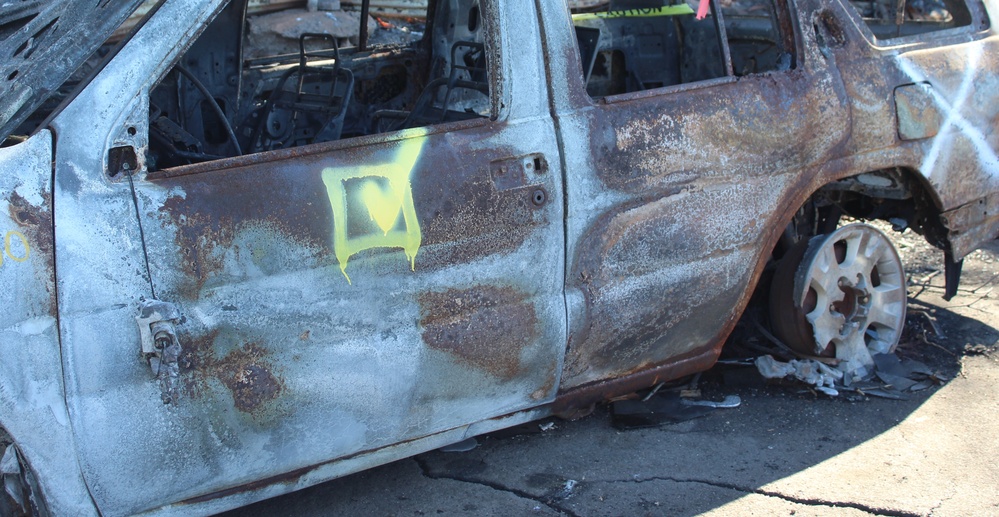
Quality Assurance Inspectors are working with USACE contractors and County of Maui representatives to facilitate vehicle removal from the right of way in Lahaina, Hawai‘i, Nov. 3. The county marks the vehicle with a yellow box and check mark signaling that the vehicle is ready for removal.
LAHAINA, HI, UNITED STATES
12.18.2023
Story by Charles Delano
U.S. Army Corps of Engineers Honolulu District
The wildfires in Hawaii that resulted in loss of life and property on the island of Maui not only left Lahaina and Kula with fire debris, but also left properties with household hazardous waste or materials Items such as gas cans, propane bottles, aerosol cans, and lithium batteries were some of the materials that the U.S. Army Corps of Engineers, in coordination with the Environmental Protection Agency, have been removing.
HHM are common household materials that are flammable, corrosive or toxic, and must be removed by a trained group of hazardous materials specialists, containerized, and transported to a safe holding area for final disposition. Lithium batteries require separate precautions due to the fire hazard posed by the reactive and combustible nature of the battery chemicals.
“All the recovered lithium batteries and power walls were handled by EPA utilizing an innovative process,” said Stacy Greendlinger, EPA specialist. “The state, county, and other federal partners were not involved in the de-energizing and decommissioning of the batteries.”
USACE is responsible for the final disposition of electric vehicle chassis but before these chassis can be removed from personal property, the EPA must identify and remove any lithium batteries. According to Greendlinger, the EPA has removed lithium batteries from 94 electric and hybrid vehicles and 274 power walls, and shipped more than 30 tons of lithium batteries from Maui to a processing facility in Reno, Nevada.
“The EPA has completed the assessment and removal of lithium batteries in Lahaina and Kula,” said Jason Phillips, Emergency Field Office resident engineer. “We have removed vehicle chassis impeding the rights-of-way in Lahaina and Kula during phase one, and are removing the vehicle chassis on private property during phase two.”
Private property debris removal in Kula is anticipated to be completed in December 2023 with PPDR anticipated to begin in Lahaina in January 2024.
“The presence of lithium batteries has not impacted fire debris removal,” said Cory Koger, USACE debris subject matter expert. “We have good communication with the EPA and, through a team effort, we are able to remove the batteries as well as the vehicle chassis and power walls.”