http://dlvr.it/T2Xqvx

By ROSE L. THAYER STARS AND STRIPES • January 31, 2024
Read more at: Source - Stars and Stripes
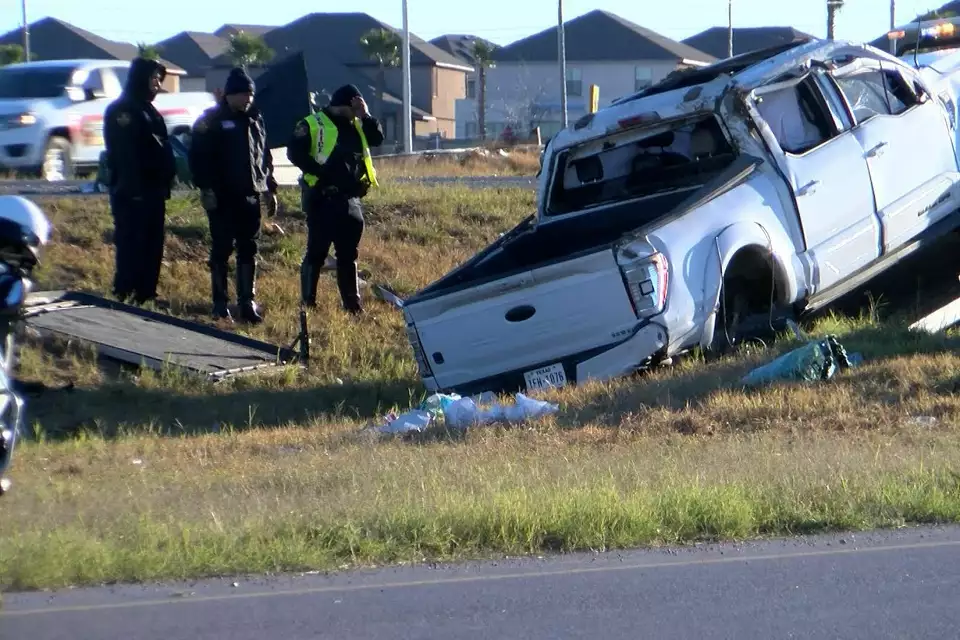
AUSTIN, Texas — Two National Guard soldiers were involved in a car crash early Monday morning in south Texas that killed the passenger. When the driver could not save his fellow soldier, he shot himself dead at the scene, local police said. Dawit Befakadu Girma, 21, was driving the white Ford F150 and Daniel Luis Molina, 27, was in the passenger seat when the truck rolled over near Laredo at about 1:30 a.m. near Texas State Highway Loop 20, said Officer J. Espinoza, spokesman for the Laredo Police Department. Molina was thrown from the vehicle during the crash. An investigation into what caused the truck to rollover continues, he said. Other people on the road stopped to help and told police that Girma attempted to save Molina’s life with CPR. When he couldn’t, he took a handgun from his waistband and shot himself dead. Both men were taken to a hospital where they were pronounced dead, Espinoza said.

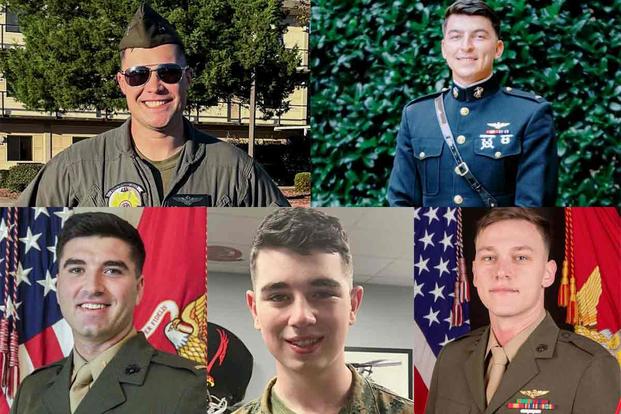
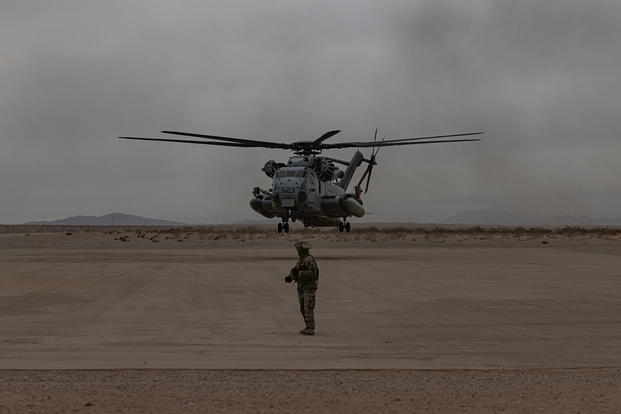
The Pentagon believes it has identified the mechanical failure in an Osprey aircraft that led to a fatal crash in Japan and the grounding of the fleet for two months
By TARA COPP Associated Press
February 6, 2024, 5:41 PM
WASHINGTON -- The Pentagon believes it has identified the mechanical failure that led to a fatal crash of an Osprey aircraft in Japan and the grounding of the fleet for two months, a U.S. defense official told The Associated Press. It is now weighing how the aircraft can be returned to service.
The Pentagon’s Joint Safety Council is now working with the Air Force, Navy and Marine Corps on their plans to get Osprey crews ready to fly again, said Navy Rear Adm. Chris Engdahl, chairman of the council and commander of Naval Safety Command.
The Air Force investigation is continuing into the Nov. 29 Air Force special operations command CV-22 crash, which killed eight service members. The crash led to a rare grounding on Dec. 6 of about 400 Osprey aircraft across the three services. Japan also grounded its fleet of 14 Ospreys following the crash.
The official who said the mechanical failure had been identified declined to say what the failure was. It has opened the door to discussions on return to flight because mitigations can be put in place. The official was not authorized to discuss the investigation publicly and spoke on condition of anonymity.
While each service will determine when it returns its own fleets to the skies, the council is talking with “commanders across the services on what are their plans to come back to flight, what are their risk decisions,” Engdahl said. “In aviation, they’ve done this before, but probably not on this broad scale with a platform like we have in the V-22” Osprey.
That could include getting service-wide input on how many simulator hours are needed to get a crew back to proficiency, with what type of flying, and what maintenance is needed on each Osprey before they go up in the air again, Engdahl said.
Flight safety is dependent on pilots maintaining currency on an aircraft — meaning that they are flying regularly enough to be proficient in all types of flying, such as night missions, close formation flying or refueling. After 60 days of being grounded, that will be one of the key issues the services must prepare for as the Ospreys return to flight.
They also must make sure the aircraft are ready. Both the Air Force and Marine Corps have been running the Osprey's engines; the Marines have been conducting ground movements to keep the aircraft working.
Marine Corps leadership is also working on a message to send throughout the service that could give each unit up to 30 days to recertify their crews and ensure they are ready to return to flight, said a second defense official, who also spoke on condition of anonymity to discuss details that have not been announced publicly.
Marine Corps spokeswoman Capt. Alyssa Myers said the service is cooperating closely with the Air Force and Navy "to make an informed decision for the MV-22’s return to flight. The safety and well-being of our personnel and the reliability of the V-22 continues to be a priority in our discussions as we determine our return to flight.”
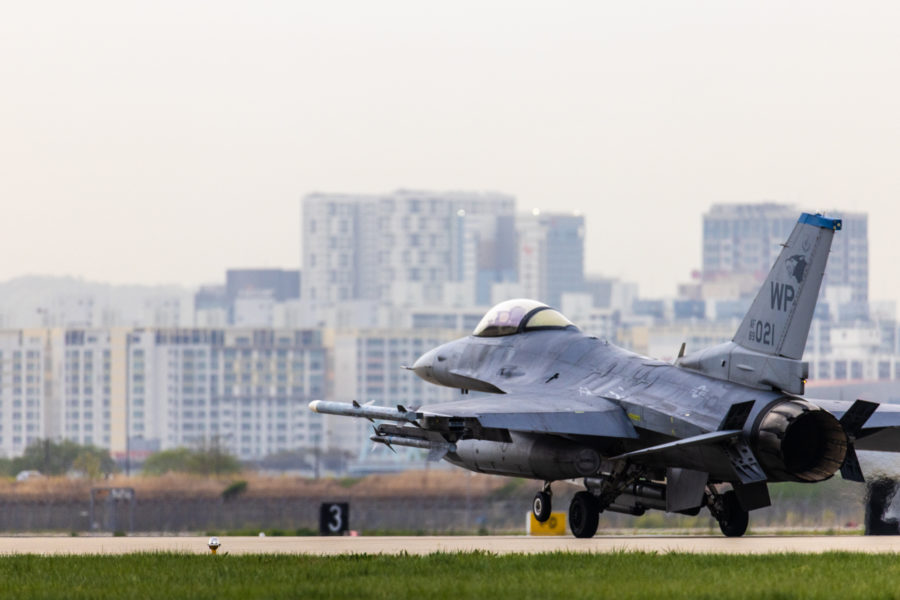 |
| A U.S. Air Force F-16 Fighting Falcon aircraft with the 8th Fighter Wing, Kunsan Air Base, Republic of Korea, taxis on the runway, during the Fiscal Year 2023 Korea Flying Training at Gwangju AB, ROK, April 14, 2023. KFT 23 is a combined training event focused on tactical execution of combat missions and is part of the ROK-U.S. alliance's routine, annual training program. U.S. Marine Corps photo by Cpl. Raymond Tong |
Feb. 1, 2024 | By Greg Hadley
Following the third crash of a U.S. Air Force F-16 in South Korea in nine months on Jan. 31, the head of the 7th Air Force released a statement saying the incidents do not appear to be related.
Some USAF flight operations have resumed on the Korean Peninsula after a brief pause, Maj. Gen. David Iverson added.
The latest crash occurred after the F-16 suffered an in-flight emergency over South Korea’s southwestern coast. The pilot ejected and was recovered safely within an hour of the crash and transported to a local medical facility for an assessment. The jet went down in the ocean.
The two previous incidents occurred May 6 and Dec. 11 last year. No personnel have been injured in any of the crashes.
In December, an F-16 from Kunsan Air Base was flying over the Yellow Sea, which borders the west side of the Korean Peninsula, when it suffered an in-flight emergency. The pilot ejected safely. The investigation of that incident is in its “final stages,” Iverson said in his statement.
Last May, a routine daytime training sortie went sour when something went wrong and the pilot ejected near Osan Air Base, about 80 miles north of Kunsan. The fighter made a fiery impact in a local field, which was captured by local cameras. Iverson said the incident has been investigated, but results have not been released. Air Force Accident Investigation Board reports are typically published.
After the latest incident, the 7th Air Force paused flying operations to focus on search and recovery operations. Iverson said “some” flying ops began again Feb. 1, though he did not specify which.
“I also want to acknowledge that this is the third F-16 crash on the peninsula in the last nine months. Thus far, including the preliminary findings from yesterday’s mishap, there are no indications these incidents are related,” he said.
From 2010 to 2021—the latest year for which the Air Force Safety Center has published statistics—33 F-16s have been destroyed in mishaps, or 2.75 per year. Six fighters each were destroyed in 2013 and 2015.