Thursday, April 4, 2024

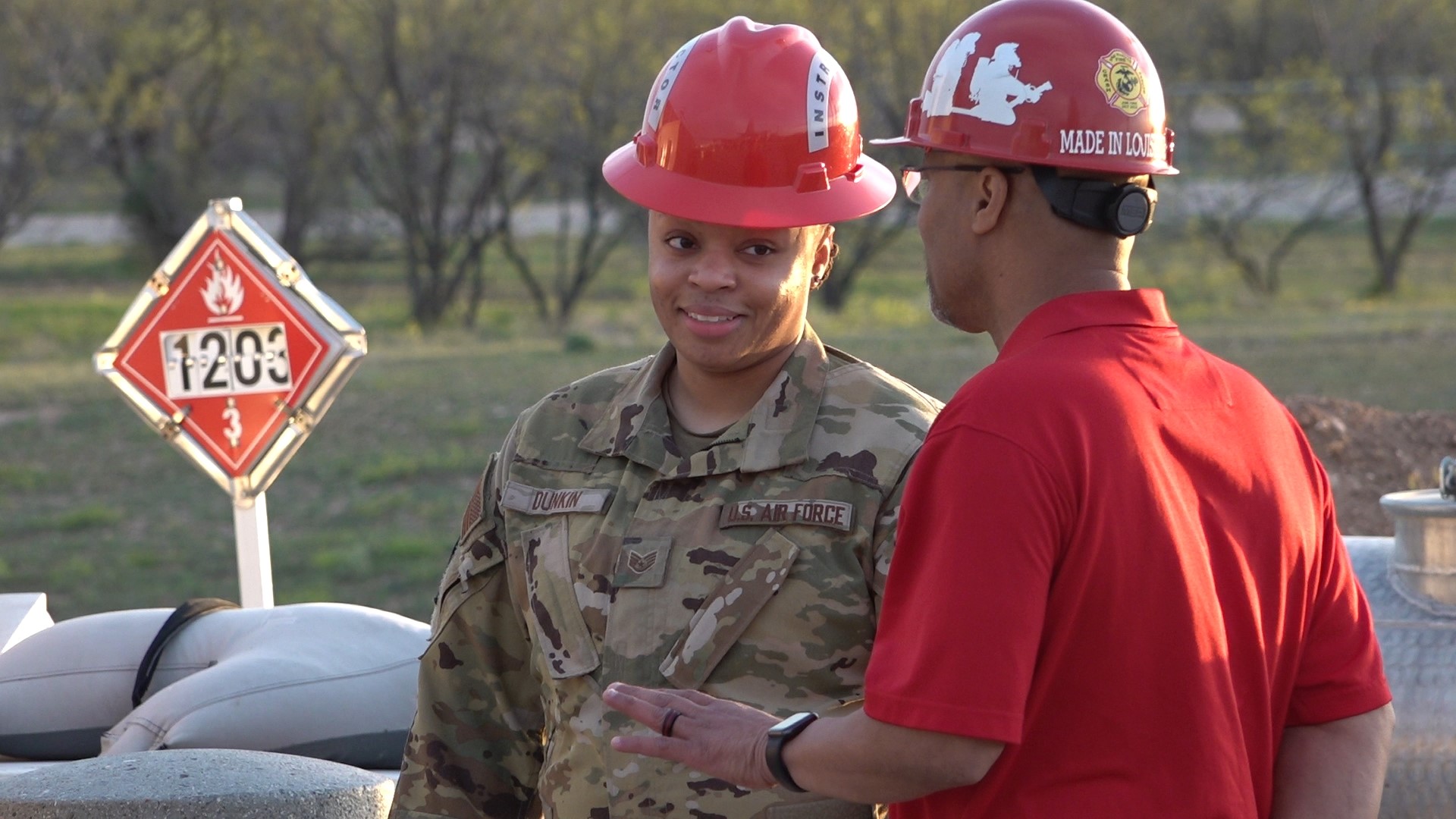
Goodfellow AFB female fire instructor hopes to inspire trainees.


Staff Sgt. Shatora Dunkin is well-respected by her peers. She is one of few female fire instructors at the Louis F. Garland DoD Fire Academy at Goodfellow.

Author: Shawn Humphrey

Published: 11:56 AM CDT March 29, 2024

Updated: 11:56 AM CDT March 29, 2024

SAN ANGELO, Texas — US Air Force Staff Sgt. Shatora Dunkin's peers and superiors spoke highly of her before hazardous materials training Friday morning at Goodfellow Air Force Base. 

Dunkin is one of only a few female fire instructors at the Louis F Garland DoD Fire Academy at the base. She gave her previous instructors credit for shaping her teaching style and said her upbringing laid the foundation for the way she treats people.

"I’m from the South, so we are big on respect," she said. "If you didn’t say or do the right thing you would get repercussions. So, it was instilled in me to always show respect, and I’m big on treating people like people."

Dunkin said becoming an instructor was challenging, but said her mentality has carried her through the difficulties she has faced in the Air Force. She said she wants to inspire other people to follow behind her and push her students the same way.

"You have to understand that you can do what the other guys are doing," she said. "It may take a little bit more, but as long as you keep putting your right foot in front of your left and your left in front of your right and never stop, you’ll be alright."

Dunkin said she wants to become a first sergeant in the future and continue helping people in her role as a firefighter.


Wednesday, April 3, 2024

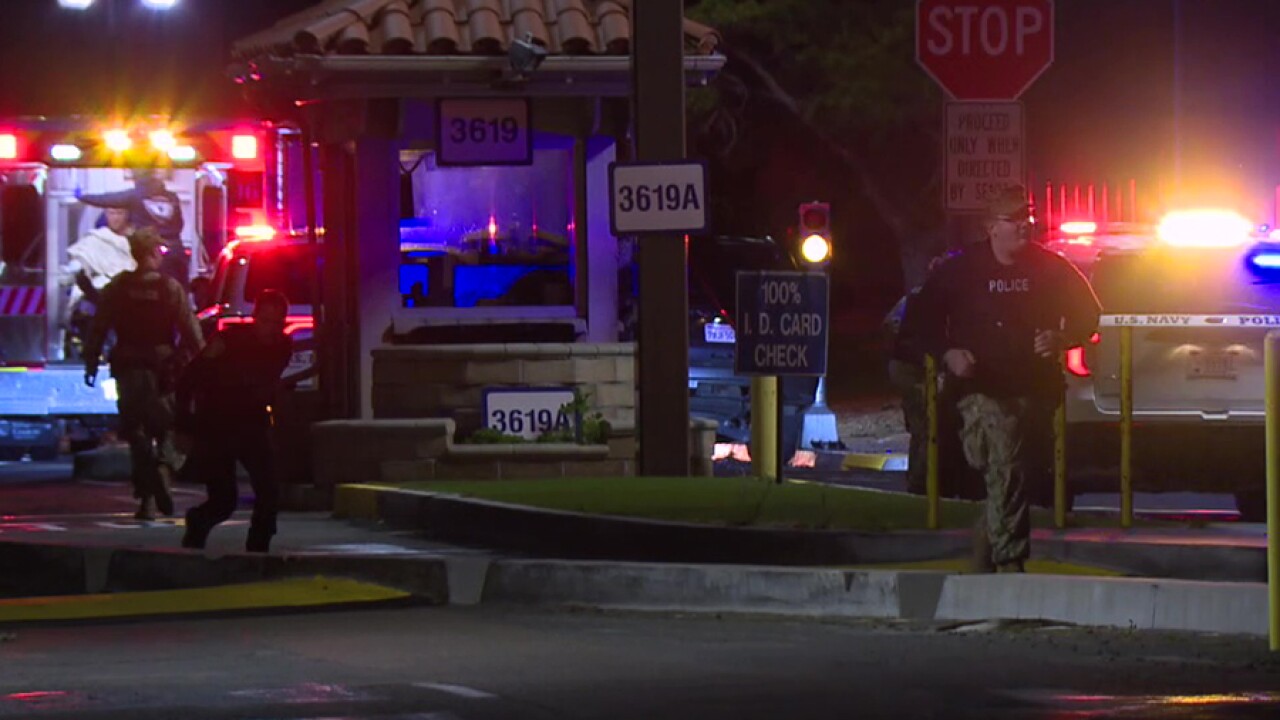
Three military members were hospitalized following a vehicle crash at the gate of Naval Base San Diego


    Three military members were hospitalized following a vehicle crash at the gate of Naval Base San Diego on Wednesday morning. The incident involved a Ford Expedition SUV and occurred on Norman Scott Road as emergency crews responded to the scene.

Naval Base San Diego Public Information Officer Krishna Jackson provided an update on the collision, stating that an unmarked base vehicle attempted to bypass the guard shack at the gate around 4:30 a.m. Despite the presence of security personnel at the guard shack, the vehicle tried to bypass it, leading to a security guard activating a barrier that the car ultimately crashed into.

In response to the crash, base officials deployed the gate security barrier as a precautionary measure to prevent unauthorized entry. The occupants of the vehicle, identified as military members, were taken to a local hospital for evaluation. One member was released after treatment, while the other two remained under evaluation.

While there was no threat to the public, the crash impacted traffic in the area. Naval Base San Diego redirected traffic to Gate 29 on Main Street and Gate 32 at Yama and Main Street. Gate 32 continued to operate normally, with two gates on the dry side open until 7 p.m. and Gate 43 serving as an alternative entrance.

Military officials are conducting an investigation into the circumstances surrounding why the vehicle attempted to breach the gate.


Fire Breaks Out at Fort Carson Military Base in Colorado

March 29th 2024

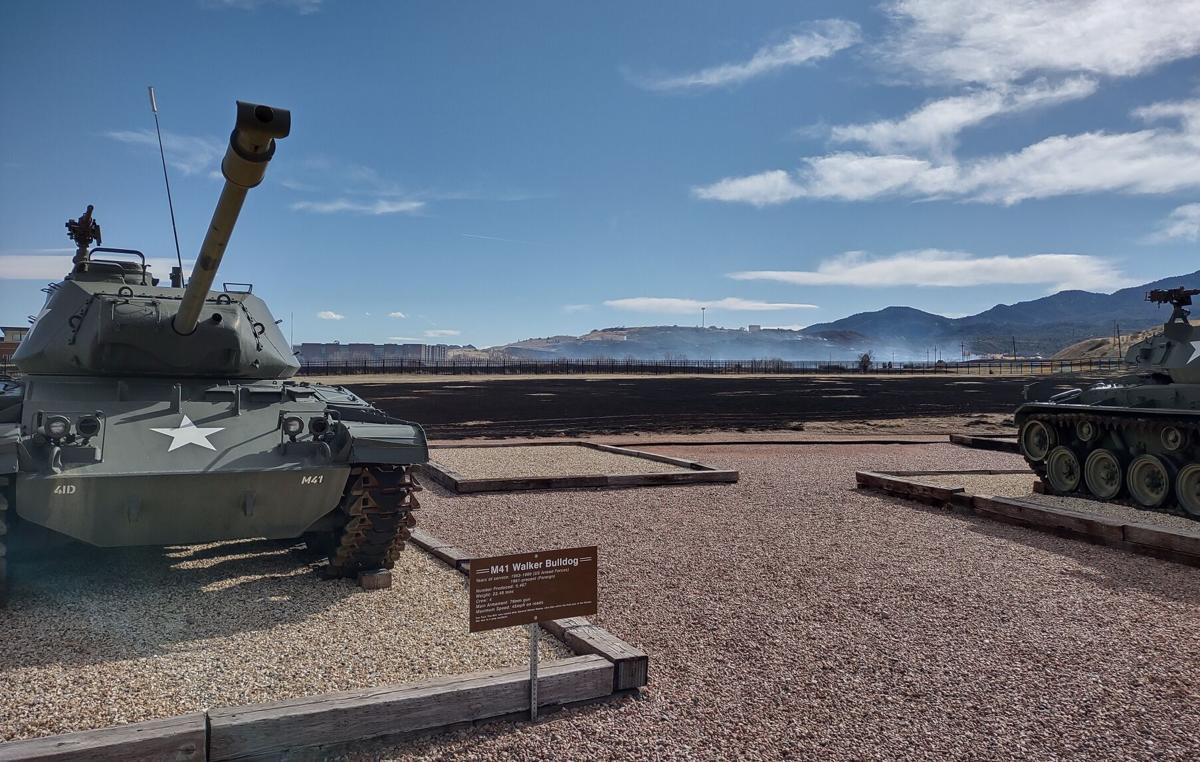
A fire ignited on the grounds of Fort Carson military base in Colorado, prompting a swift response from firefighters. The blaze reportedly started behind Patriot Elementary School around 1 p.m., initially covering approximately 10 acres and emitting thick smoke visible across Colorado Springs.

By 3:30 p.m., firefighters reported that the fire had expanded to 106 acres and was 20% contained. While they deemed the fire "under control," continuous monitoring was planned throughout the night due to concerns about high winds exacerbating the situation.

Scheduled controlled burns at the military base were canceled due to the windy conditions, with the cause of the fire remaining unknown at this time. Although Patriot Elementary School was evacuated, no students were present as the school was on spring break.

Precautionary pre-evacuation orders were issued for the Sam Houston Loop within the Dakota Ridge subdivision. Additionally, both Cheyenne Mountain Child Development Center and Patriot School Age Services were evacuated to the youth center for safety measures.

Gate 1 of the base was closed to inbound traffic, permitting only emergency vehicles to exit the area. Authorities continue to monitor the situation closely as efforts to contain and extinguish the fire progress.


New Air Force Safety Plan Focuses on Nukes, Space, and ACE


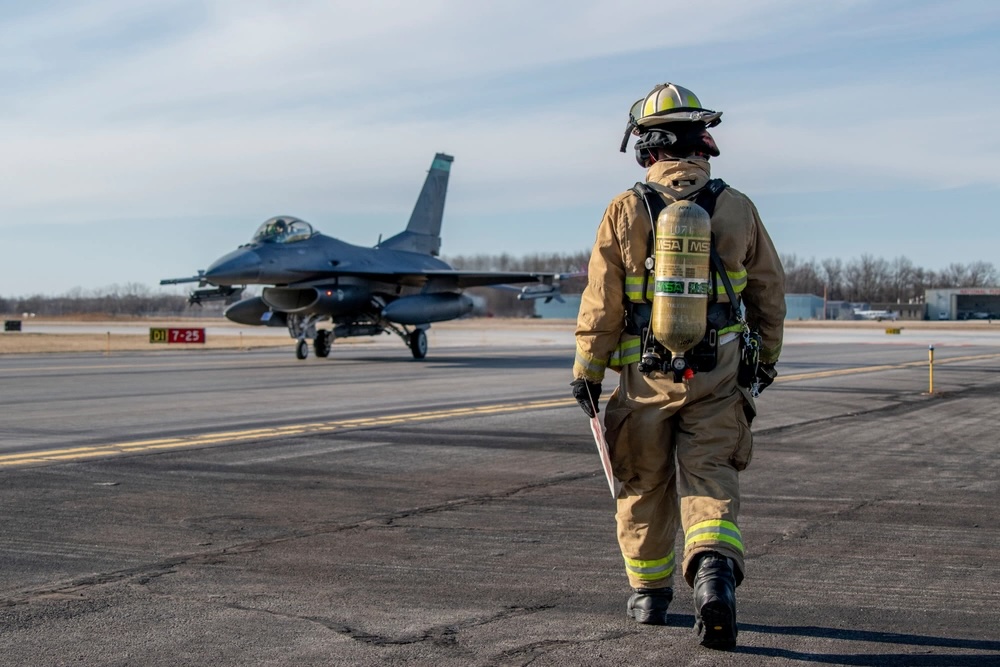
U.S. Air Force Master Sgt. Justin Askins, a firefighter assigned to the Ohio National Guard’s 180th Fighter Wing, walks towards an F-16 Fighting Falcon during an F-16 recovery exercise at the 180FW in Swanton, Ohio, March 8, 2023. (U.S. Air National Guard photo by Staff Sgt. Kregg York)

April 2, 2024 | By David Roza

The Air Force Safety Center unveiled a new strategic plan meant to help keep pace as the Air Force writ large expands its operations in space, updates its nuclear inventory, and aims to move faster in combat than it ever has before. 

“As safety leaders, it’s our job to ensure the safety enterprise is trained, agile, and ready to integrate new Air Force operational concepts to deter, and if needed defeat, great power competitors,” Maj. Gen. Sean Choquette, the Air Force’s chief of safety and commander of the safety center, said in an April 2 release. “Safety’s job is to prepare our forces with the resources and skills to make risk-informed decisions at home or in combat.”

The DAF Safety Strategic Plan 2024-2027 lays out six goals meant to keep safety in the front of mind for Airmen and Guardians. One of them is to strengthen nuclear surety, which is the term for keeping nuclear weapons safe, secure, and reliable. 

The Air Force has struggled with nuclear surety in the past: in 2007, the service mistakenly flew nuclear weapons on a B-52 from North Dakota to Louisiana and left the bomber unguarded for about nine hours. That incident helped lead to new training procedures, standards, and the creation of Air Force Global Strike Command to oversee nuclear surety. 

Nearly 20 years later, the Air Force nuclear enterprise has major changes on the horizon as the service seeks to replace its aging Minuteman III intercontinental ballistic missile with the Sentinel ICBM. The Air Force also plans to buy at least 100 nuclear-capable B-21 bombers, and last month the F-35 fighter was certified to carry a nuclear bomb.

“Given the criticality of nuclear surety, the renewed focus on this capability, and the rapid growth of related programs, DAF Safety will continue ensuring the nuclear surety programs are correspondingly robust, comprehensive, and responsive to support this mission area,” the Center wrote.

The steps to get there involve developing a better nuclear surety operational assessment program; coordinating a plan to comply with new Defense Department standards, updating the Air Force’s nuclear surety policy, and upgrade the safety center’s mishap reporting system for “dull swords,” the term for nuclear events or deficiencies not categorized as an accident. 

The Air Force Safety Center also seeks to integrate risk management into agile combat employment (ACE), the concept where small teams of Airmen launch and recover aircraft at remote or austere airfields, then relocate to avoid being targeted by enemy missiles. Many Airmen expect to carry out those operations without support and without connection to higher command, which is forcing a wider recalculation of risk across the service.

“We’re trying to teach our aeromedical evacuation members to assume risks that they probably would not have in the last 20 years when it comes to patient care,” one aeromedical evacuation Airman told Air & Space Forces Magazine in June. 

“We are boiling down to old-school World War II tactics where we use rope, tape, and zip ties to pull submunitions off a runway all at once,” an Air Force Explosive Ordnance Technician added.

The Air Force Safety Center wants to update its framework for calculating risk in the age of ACE, which will start with a six-month evaluation of its risk management practices. The center aims to implement an initial version of an update plan within two years, followed by a full one within five.

But to be effective, whatever new plans are developed need to be practiced in the field.

“Ultimately, our safety mission success relies upon the disciplined approach of individual Airmen and Guardians—you are the vital component of the enterprise,” the center wrote.

To get after that, the first goal of the plan is to fully integrate risk management into all training and operations. The goal involves reviewing the “safety enterprise processes” for irrelevant tasks, launching a public affairs campaign on safety and risk management, and formalizing safety principles and risk management as Air Force core competencies.

Another Air Force Safety Center goals is to keep pace with the Space Force. Its objectives include developing a plan of action and milestones, determining the authorities for overseeing space safety within the Air Force and the wider Defense Department, and conducting a baseline manpower study in support of the space enterprise.

Beyond keeping pace with the new changes, the safety center wants to get ahead of the curve by using machine learning models to analyze safety data, providing better analysis to commanders through data visualization, and working with wing or delta safety offices to improve their processes.

“Mishap reporting data is a lagging indicator and limited tool,” the center wrote. “Our intent is to develop analytical tools to assist commanders with proactive risk reduction, mishap prevention, and maximized readiness.”

The Air Force Safety Center’s last goal is to modernize the safety workforce, largely by revamping formal safety education such as the Air Force Safety University. The center plans to take a look at the university’s infrastructure, budget, and course catalog.

Over the next few years, the safety center will set up offices of responsibility to oversee implementation of its strategic plan. 

“Measuring success must be done by measuring results and outcomes,” the center wrote. “Success is not measured by checking off milestones passed or objectives completed.”


Alaska Air National Guard Medevacs Critically ill Patient


NEWS | April 2, 2024
Alaska Air National Guard Medevacs Critically ill Patient
By David Bedard, 176th Wing Public Affairs

JOINT BASE ELMENDORF-RICHARDSON, Alaska - Two Alaska Air National Guard Airmen jumped from a 176th Wing combat search and rescue aircraft into the village of Kotlik March 22 to expedite medical care for a critically ill patient and evacuate her to Joint Base Elmendorf-Richardson.

The mission began in response to a request from the Yukon-Kuskokwim Health Corporation to medevac a patient experiencing internal bleeding from Kotlik to Bethel for a higher level of medical care.

Civilian air ambulances could not support the medevac due to poor weather in the region.

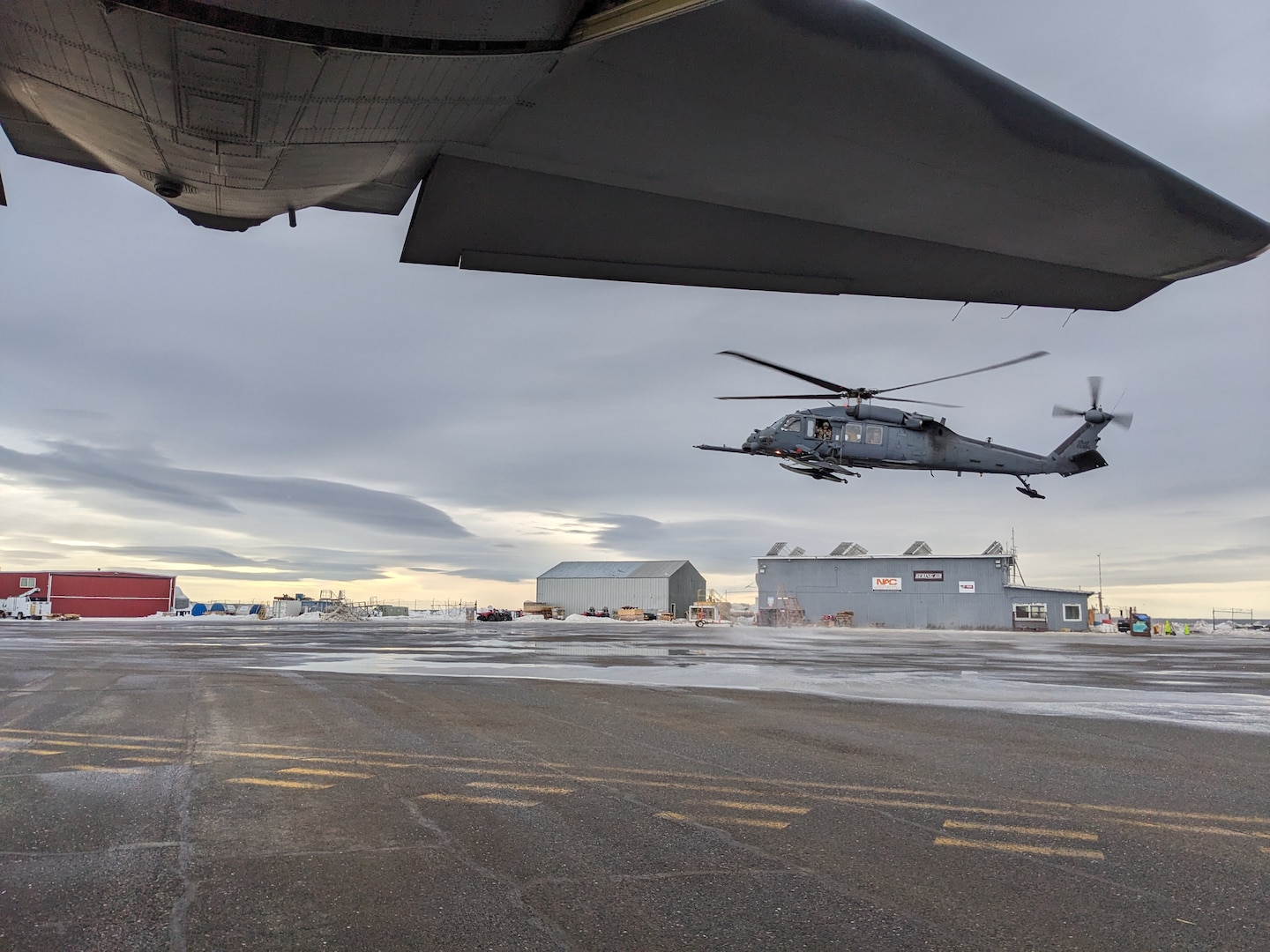
The Alaska Rescue Coordination Center communicated the request to the 176th Wing search and rescue duty officer, who dispatched a 210th Rescue Squadron HH-60G Pave Hawk combat search and rescue helicopter and a 211th Rescue Squadron HC-130J Combat King CSAR fixed-wing aircraft. Both platforms carried Guardian Angel personnel recovery teams comprising combat rescue officers and enlisted pararescuemen.

For most civil search and rescue missions in Alaska, patients and distressed residents are recovered by the HH-60 due to its ability to land or deploy its rescue hoist just about anywhere. Because time was of the essence for the patient, mission planners decided to jump a GA team from the faster HC-130. 

“Our goal was to get to Kotlik as fast as possible,” said Alaska Air National Guard Master Sgt. Arnold Perea, 210th RQS HH-60 special missions aviator. “We had the C-130 go out ahead to do weather reconnaissance and see what the status was over top of Kotlik because we heard there was bad weather there. When they got there, they could see that it was clear enough for them [to jump] since they can get there quite a bit faster than us.”

Maj. James Byrne, 212th RQS combat rescue officer, and Master Sgt. Daniel Lutz, 212th RQS pararescueman, said the patient’s condition made jumping an urgent choice.

“The patient had significant internal bleeding. She was experiencing low blood pressure and had a rapid pulse,” Lutz said. “That pushed us towards launching the Herc faster than we normally would, hoping to get blood onboard sooner rather than later. We retrieved two units of blood from the hospital: one unit on the helo, one unit on the Herc. We stepped out the door with the mindset of jumping to the patient, knowing the helicopter was going to be several hours behind us.”

Village residents were waiting with snowmachines at the drop zone in a field near Kotlik, ready to bring the Guardian Angels to the village clinic.

Orbiting over the drop zone, Byrne said they had to consider ceiling, visibility and wind.

“We had the ceiling, the visibility was good enough for us to jump, and the winds were higher than what we typically jump for training, but based on the DZ location and the terrain, all of the snow out there, as a highly proficient jump team, anyone [in the 212th RQS] could have made that jump,” Byrne said. “As a crew, we assessed the situation and risk factors and determined that it was still appropriate to conduct the jump.”

Byrne and Lutz tossed wind streamers and an electronic wind drift indicator out of the aircraft door to measure the gales, but the devices’ swift disappearance in the weather rendered them useless.

The GAs turned to Maj. George Geiges, the 211th RQS combat systems officer on the HC-130 flight deck, who had all the tools necessary to calculate a good area to OK the jump.

“A crew-directed drop is one where the aircrew will pull tab data from charts and put it into the system on the aircraft,” Geiges said. “The system plots where we can release. It gives us a LAR, a launch acceptability region, meaning we can drop the jumpers anywhere in that area, and their chute maneuverability gives them the ability to steer a little bit, and that is plotted out from a wind vector.”

With the proper calculations, the GAs exited the aircraft door into the cold, gusty Alaska night.

“Once we got out, we realized the winds were pretty manageable, so we turned and ran with the wind, traveling the 1.7 miles to the drop zone,” Lutz said. “Once we neared the target area, we turned into the wind and were pushed back the remainder of the distance to the drop zone. At 1,000 feet, we disconnected our reserve static lines. If you cut away [the main parachute], the RSL pulls out your reserve. Doing this allowed us to cut away our mains on the ground and not be drug by the high winds.”

With as much as 80 pounds of medical and survival equipment strapped to their legs, the GAs pulled the release on their 15-foot lowering lines, and their gear hit the snow before they did.

“The landing itself was pretty easy,” Lutz said. “It was a slight flare [of the parachute], and we both had stand-up landings and cut away the parachutes.”

At the clinic, the GAs met with the village health aide who had been providing medical care for the ill resident.

“She was a very sick patient,” Lutz said. “You could definitely tell by her color and vitals she had been losing blood.”

Byrne said the team had more work to do before loading her on the HH-60 that had made its way through the weather to Kotlik.

“The most appropriate option was to be able to provide a medical intervention as quickly as we could versus evacuating her out as quickly as we could,” Byrne said. “We talked to a doctor in Bethel and relayed some of the information and the vitals we were seeing in real-time, and then we were given the recommendation to push blood.”

The original plan for evacuation to Bethel fell through due to many of the same circumstances that prevented civilian air ambulances from responding.

“We were trying to transload her to Bethel, but there was a band of weather between Kotlik and Bethel, so we had to divert to McGrath and do the transload to King there,” Perea said.

With the patient and the GAs onboard the HC-130, they departed McGrath for JBER, where the patient was transferred to the Anchorage Fire Department for transport to an area hospital.

Geiges said the mission was unique because of the level of teamwork required.

“We call ourselves the Rescue Triad, but in a lot of missions, one element stands out more than others, and I think this mission is a perfect example of that Rescue Triad working together. Each team was completely reliant on the others,” Geiges said. “We needed the GAs, the HC-130 and the HH-60 to get this mission done. I think it’s a great example of how that triad works here in Alaska.”

For the mission, 210th RQS, 211th RQS, 212th RQS and the AKRCC received credit for one save.


Most Viewed Articles