Ready for family fun at the beginning of Presidents Day weekend in February, Marine Gunnery Sgt. Max Frost; wife Arielle; and the couple's three sons, Ryker, Liam and Colton, headed to the base bowling alley in Twentynine Palms, California, only to find it closed. Calling an audible, they decided to head to town to go toy shopping and pick up supplies for the family's pet hermit crab.
As they approached the busiest intersection on base, Frost saw a green light and began to proceed through the intersection, never seeing the military police vehicle speeding toward the family. If the car had its siren on, the Frosts never heard it -- the sport utility vehicle broadsided the family's Dodge Grand Caravan, shattering its windows, exploding the airbags and spinning the van nearly twice around.
When the Caravan finally came to a rest near a pole, Liam was crying, Colton was in shock and Ryker, in the third row, wasn't moving, his head slumped over at an unnatural angle. Arielle crawled through the twisted metal to reach her grievously injured son. He didn't have a pulse.
"There was a corpsman who helped me triage him," Max Frost said during an interview. "He said he was cyanotic. I asked what that was. They already were preparing us that he might not make it."
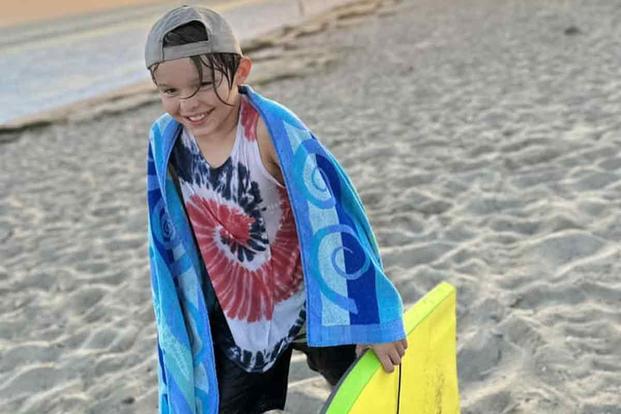
Ryker and Liam were airlifted to the children's hospital in Loma Linda, where Liam would recover from his injuries, but Ryker, 10, would not. The Frost family was given time to say goodbye, and on Feb. 18, their joyous, happy-go-lucky son, who loved "Star Wars," the beach, sports, painting and music, died.
If the asphalt at the intersection could tell a story, it would say the military police driver never hit the brakes. Friends returning to the scene later found no traces of skid marks.
In the weeks following the crash, the Frosts learned that the military police officer was responding to a report of a suspected breach of the installation's Condor Gate, a small security shack that stands sentinel between the sprawling Marine Corps Air Ground Combat Center and the Mojave Desert.
A similar incursion had occurred just five months before at the Condor Gate. On Sept. 22, a trespasser breached the gate, was apprehended and subsequently released off base. Shortly after, the suspect then breached the Main Gate, resulting in the discharge of a firearm at the suspect's vehicle.
And just this week, the Condor Gate made the news when another alleged gate runner, identified by a Customs and Border Protection agent as a Chinese national, trespassed onto the base.
The Frosts say that, with the September incursion, the base provost marshal office should have instituted security improvements and stepped up training for those responsible for preventing breaches to ensure the safety of the nearly 50,000 people who live and work at what is, by area, the world's largest Marine Corps base.
Following the loss of their son, they want it done right now.
"In the weeks following the September incident or the week following our accident, there were no enhanced security measures," Arielle Frost said. "We would like them to build the infrastructure to immediately decrease the ability of people to just blow right through the gate."
According to Arielle Frost, at the Condor Gate, which is near a housing complex and an elementary school, the barrels of sand meant to thwart errant vehicles are not filled, the gate arm is left open nearly around the clock, and the attitude toward security is lukewarm at best.
"We'd like them to at least publicly acknowledge what happened. ... There is a housing area right there, and all these gate runners are going right by those homes, and families need to know that safety is compromised."
Officials at the Marine Corps Air Ground Combat Center said the accident remains under investigation, and there is "no new information available at this time." Second Lt. Kristian Floyd, an engagements officer with the Marine Corps, referred all questions to the Naval Criminal Investigative Service.
Darwin Lam, a public affairs specialist with NCIS, said that out of respect for the investigative process, NCIS "will not comment further while the investigation remains ongoing."
"Our deepest condolences go out to the family of the young boy," Lam said in an email to Military.com.
The Frosts say they understand the investigative process and a desire for the base officials not to interfere or exert influence on the ongoing investigation but also say that to not issue a press release or discuss the security issues that have occurred on base is wrong.
"I want whoever is responsible to come out and just acknowledge what is for us such an obvious problem," Arielle Frost said.
In September, The Wall Street Journal reported that more than 100 Chinese nationals have attempted in the last several years to access U.S. military installations and other critical government sites.
Those include attempts to forcibly gain access to Fort Wainwright, Alaska, and illegally entering Naval Air Station Key West, Florida, to take photos.
Shortly after The Wall Street Journal story ran, Pentagon spokesman Maj. Gen. Pat Ryder said the "security of our installations remains a top priority and that physical security standards for our bases takes into account a wide variety of potential threats, to include attempted spying by our adversaries."
He added that a recent review by the Defense Department focused on the physical security conditions of installation gates. According to Ryder, more than 10,000 controlled turnarounds occur each day at the U.S. military's roughly 1,400 gates worldwide.
Of those, he said, a "very small number ... warrant additional checks, and even a smaller number warrant an investigation."
In other cases of gate breaching that often involve suspects fleeing from law enforcement or traffic accidents, Air Force security personnel fired shots at a driver who crashed through the main access point to Joint Base San Antonio-Camp Bullis, Texas, and a Navy petty officer died at Joint Expeditionary Base Little Creek-Fort Story in Virginia when a driver tried to run the gate and hit a base security vehicle.
Arielle Frost said the couple would like to see the threat protection level increased at all Marine Corps installations, as well as improved training and instruction of responders across the board.
"What type of culture puts it in the PMO's mind that he thought going through the busiest intersection on base in the middle of the day without yielding to the red light or using caution was a good idea," Arielle Frost said.
With such tragic memories at every corner of the Twentynine Palms installation, the family was given a transfer to their previous duty station at Camp Pendleton, California. Max Frost, who had been serving with the Tactical Training and Exercise Control Group at MCAGCC, had nothing but praise for his unit's response to the accident and is particularly grateful to his commanding officer, Col. David Hart, who actually witnessed it.
"I've never been as proud to be a part of TTECG, seeing them in action after the accident. The amount of support they've given us is unreal," Max Frost said.
The family will never stop grieving their beautiful boy who was described in his obituary as the "embodiment of love, humor, bravery and intelligence."
But they hope that his legacy will be to improve safety and security on Marine Corps installations.
"We do not want anyone else in this Marine Corps family to go through something like this. Our son's legacy and honor was one of laughter and joy, and we don't want this lack of oversight to take that from anyone else," Arielle Frost said.