Thursday, April 11, 2024

Babies exposed to PFAS weigh less at birth, earn less as adults, study finds


BY: CHRISTOPHER INGRAHAM - APRIL 11, 2024 3:46 PM

People born in the 1970s and 1980s near military bases with high levels of groundwater PFAS contamination had lower birth weights, were less likely to graduate college, and today earn less money than similar individuals who were not exposed to high levels of PFAS, according to a new working paper by economists at Iowa State University and the U.S. Census Bureau.

The paper was released on the same day the Environmental Protection Agency finalized stringent new regulations on so-called “forever chemicals.” The study, which according to its authors “provides the first causal, national-scale estimates of exposure to a source of PFAS contamination on health at birth and adult earnings,” underscores why federal authorities are cracking down on the chemicals — and suggests cleaning up environmental PFAS will yield considerable public health and economic benefits.

Maplewood-based 3M invented and manufactured many of the chemicals, which are used in coatings and thousands of products that resist heat, oil, stains, grease and water, such as Scotchgard stain repellent, Teflon cookware, fast food wrapping and fire retardants. 

The recent study focused on specially formulated foam containing PFAS compounds, used to combat fuel fires on military bases starting in the early 1970s. Some bases conducted frequent training in the use of the foam to suppress fires, resulting in the release over time of massive quantities of the chemicals into the environment. 

Testing conducted several decades after the closure of Louisiana’s England Air Force Base, for instance, found PFAS groundwater concentrations of 20,700,000 parts per trillion. By contrast, the new EPA guidelines set the regulatory threshold at just 4 parts per trillion for two of the most-studied compounds.

But not all bases performed routine fire suppression training, resulting in a natural experiment: Were people born in the vicinity of bases with frequent fire training, and hence high levels of groundwater PFAS contamination, different from those born near bases where fire training didn’t occur?

To answer this question, the researchers collected individual-level birth data from the National Vital Statistics System and paired it to administrative records from the U.S. Census Bureau and the Internal Revenue Service. They were able to track specific individuals from birth through college enrollment and eventual workforce earnings.

They found that children born in counties with military bases where fire training was routinely conducted showed noticeable declines in birth weight starting in the late 1970s, with an average birth weight decrease of about 8 grams by the 1980s. This birth weight effect size is relative to children living near bases where fire suppression training wasn’t conducted, and is comparable to that of prenatal maternal stress caused by living among unexploded landmines.

The linked Census and IRS data, moreover, show that this setback followed the children throughout their entire lives. They were 0.6% less likely than their peers to graduate college, and reported 1.4% lower earnings on their tax returns later in life.

“The magnitude of this long-run earnings effect is comparable to that of the original Clean Air Act,” widely regarded as one of the great regulatory success stories of the 20th century, the authors write.

Cleaning up existing contamination and preventing new cases of PFAS exposure will be a long and costly process. But this study suggests it will ultimately be a worthwhile one, even when viewed through the narrow lens of dollars and cents. The authors’ back-of-the-envelope calculations suggest the total national earnings losses from PFAS exposure near military bases adds up to roughly $1 billion annually. 

That figure notably does not include the cost of all the human suffering wrought by PFAS-linked health conditions.



USAG Italy fire department prepares for return of on-post housing

By Chelsy Lyons, U.S. Army Garrison Italy April 11, 2024

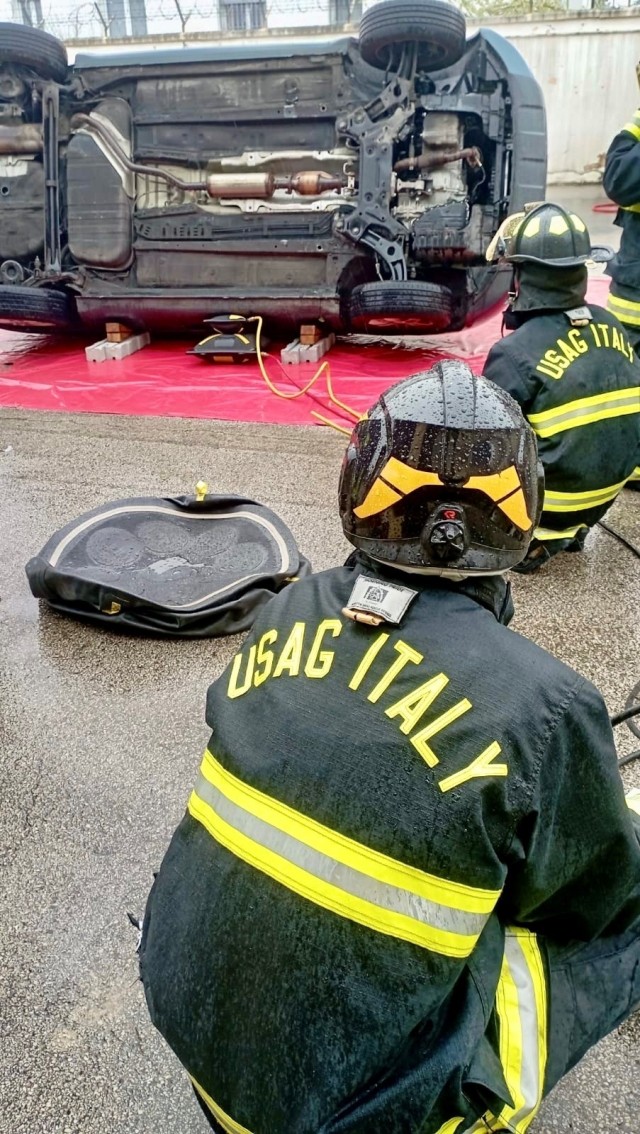
VICENZA, ITALY— With housing construction at U.S. Army Garrison Italy in full swing, the garrison’s fire department is bolstering staff and increasing training to prepare for when families once again live on post.

This quarter, they’ve onboarded eight new firefighters and have been putting their team through a rigorous, four-month academic and physical training process, said Derek Sardinta, the department’s assistant fire chief.

“We cover everything from hazardous material to medical, fire protection and technical rescue,” Sardinta said. “We are the one-stop-shop.”

Since 2021, no families have lived on post. The Army is funding a large-scale, multi-year construction project to rebuild family housing, to include 428 homes on Villaggio and 50 apartments on Caserma Ederle. Once built, firefighters must be ready to support the community.

Each firefighter completes 120 hours of training per calendar year, works 12 to

48-hour shifts, and must comply with Italian and American regulations. Within the last year, the department has gained over 200 certifications, including Hazmat Awareness and Operations, Fire Fighter I and II, and High Fire Risk.

“Every month focuses on a different subject,” Sardinta said. “In January, we focused on confined space and technical rescue. This month, it’s hazardous materials.”

The robust training program yielded exemplary results recently as the department has exceeded Department of Defense requirements. According to the DoD standards, each station must have a complete response time of seven minutes or less 90 percent of the time. The department is currently exceeding this goal at a 94 percent success rate, Sardinta said.

Things have surely changed in recent years.

In the 1990s, the garrison had an all-Italian response team off-site from the military installations. Today, it’s a full-service, DoD-regulated team. Kenneth Helgerson, the garrison’s former fire chief, took pride in the strides that his team has made in training during his tenure.

“This particular jurisdiction has gone through an evolution,” said Helgerson, who departed the department in February 2024.

The department currently consists of four fire stations, two at Camp Darby, one at Caserma Ederle, and one at Caserma Del Din. They are now looking to expand to five stations, including a facility on Villaggio, to provide increased protection for Soldiers and families.


1-111th GSAB flight crew assists with rescue/recovery mission in Florida Keys

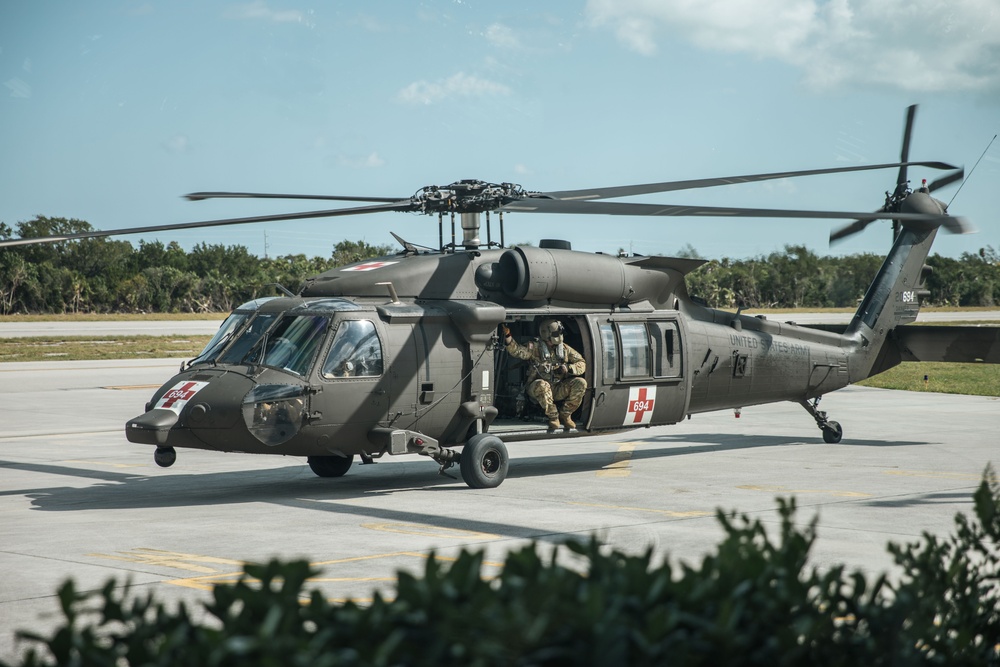
Photo By Sgt. Neysa Huertas Quinones | A UH-60 Black Hawk with the Florida Army National Guard prepares for a surveillance flight in the Florida Keys, April 8, 2024. FLANG has maintained aerial surveillance capabilities as part of migrant operations along the southern coast line. (U.S. Army photo by Sgt. N.W. Huertas) 

FLORIDA KEYS, FL, UNITED STATES
04.10.2024
Story by Sgt. Neysa Huertas Quinones 
107th Mobile Public Affairs Detachment  

KEY WEST, Fla. - Four soldiers from the Florida Army National Guard answered the call of duty as they assisted in the successful recovery of two missing jet-ski operators off the coast of the Florida Keys on March 28, 2024.

The soldiers, part of the 1-111th General Support Aviation Battalion (GSAB) Charlie Company air crew, played a critical role in the safe retrieval of a father and his 13-year-old daughter late that afternoon. Capt. Roberto Telleria, W-1 Rebecca Verran, Sgt. Justin Winegardner, and Spc. Brendeen Gonzalez demonstrated their commitment to service as they diligently searched for the missing personnel until their retrieval.

“I joined the National Guard because we help the communities,” said Verran. “I grew up knowing that during hurricanes, the NG was a local asset that came in to assist and provide aid to the community in times of need. For me, it's about helping Florida, where I grew up.”

The air crew received the call requesting aerial support shortly after embarking on their scheduled evening surveillance flight. The team swiftly adjusted course to aid in search and rescue efforts alongside U.S. Coast Guard and Florida Fish and Wildlife Conservation Commission (FWC) assets.

“ We are prepared to handle any scenario,” said Gonzalez. “ Whatever is thrown at us, we are ready for. We had all the equipment necessary to take on the task and even though this isn't considered a typical day for us, it does not change our ability to respond.”

The 1-111th UH-60 Black Hawk air crew was able to locate the second jet-ski and calculate the path the passenger would have drifted away in. The coordinates were then relayed to FWC crew patrolling the area with rescue boats while FLANG remained on site to provide coverage.

“As a crew, we collectively agreed we would do everything possible within the limitations of our aircraft to provide that air support,” said Verran. “With our aircraft, we are limited to approximately two hours of operational flight time. We were able to provide that air support as well as cover down until the U.S. Coast Guard air assets arrived on scene after fueling.”

Air crew received positive confirmation from FWC of the girls retrieval before concluding their support efforts. The Soldiers covered over 100 nautical miles during their two hour search for the missing daughter. Rescue teams estimated she had drifted at sea for approximately four hours. Upon further medical examination, both the father and daughter were cleared of any additional health concerns.

FLANG personnel continue to provide search and rescue capabilities across the southern coastline as they support joint migrant operation efforts.

5.0 5.0 out of 5 stars 
About the podcast
The "Shawn Ryan Show" is hosted by Shawn Ryan, former U.S. Navy SEAL, CIA Contractor, and Founder of Vigilance Elite. We tell REAL stories about REAL people from all walks of life. We discuss the ups and downs, wins and losses, successes and struggles, the good and bad in a respectful but candid way with our guest. We're better than entertainment, we're the REAL thing. Please enjoy the show.


Yuma Proving Ground Conservation Law Enforcement Officer assists in mine rescue

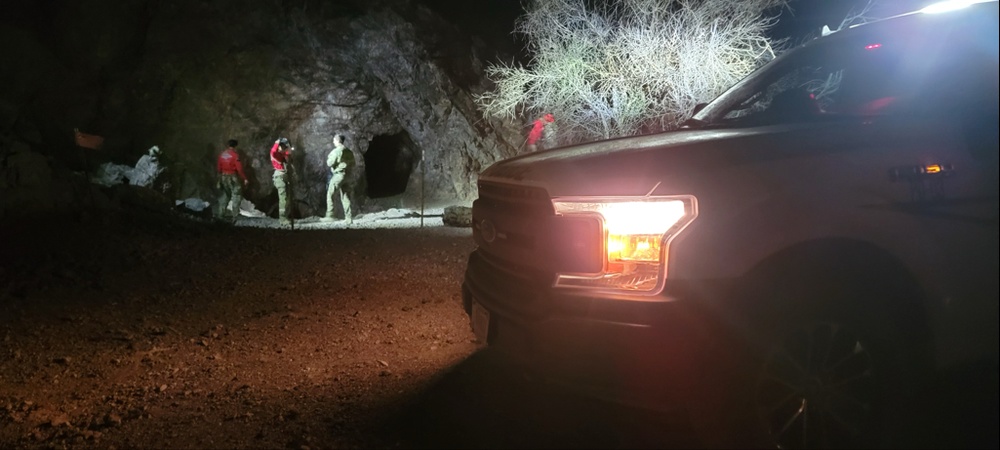
Courtesy Photo | U.S. Army Yuma Proving Ground Conservation Law Enforcement Officer Sgt. Gregory Harper assisted colleagues from the La Paz County Sheriff Department and multiple other agencies extract a woman from the bottom of a mine shaft in an extremely remote and isolated mountainous area of La Paz County, Arizona on Sunday, April 7, 2024. In this photo, U.S. Air Force paramedic jumpers can be seen entering the shaft by artificial light


YUMA PROVING GROUND, AZ, UNITED STATES
04.11.2024
Story by Mark Schauer 
U.S. Army Yuma Proving Ground  

U.S. Army Yuma Proving Ground (YPG) Conservation Law Enforcement Officer Sgt. Gregory Harper is getting high praise from the La Paz County Sheriff Office (LCSO) for his recent assistance with a mine rescue.

For many harrowing hours, personnel from multiple law enforcement and government agencies responded to extract a woman stuck at the bottom of a 200-foot deep mine shaft.

According to social media posts from LCSO, the woman was ultimately rescued and transported to Yuma Regional Medical Center, where she was reportedly in stable condition.

“That was an interesting thing to be a part of, for sure,” said Harper.

Harper was helping a neighbor of his parents in Yuma while off-duty the afternoon of Sunday, April 7 when a LCSO Deputy he has had professional dealings with called. His agency had received a 911 call about the mishap in a mine located in an extremely remote area about a mile and a quarter outside of Yuma Proving Ground’s boundary. The YPG Police Department frequently lends a hand to law enforcement agencies in the surrounding area, and Harper was particularly intent to help given the treacherous topography of the area.

“When he briefed me what was going on and advised me how far out he was, I jumped in my truck and headed straight into work and got geared up,” Harper recalled. “Typically, because we know the range as well as we do we’ll assist even if it is our day off. We know a lot more of the risks out there and what routes you should and shouldn’t take—you could really compound the situation if you send in someone unfamiliar with the terrain.”

In the process of traversing the vast distance between Yuma and the remote area of La Paz County he called a wildlife officer from the U.S. Fish and Wildlife Service that he has worked with. Both men had extensive knowledge of the rugged and roadless mountainous terrain in the vicinity and met up near the site, where they encountered a friend of the trapped woman who was seeking cell phone signal to check in with LCSO. She took both officers to the area where her friend had the mishap. Adding to the tension, the trapped woman’s two children were on the scene worried for her safety.

“The last thing that had been reported to me was that she had a broken ankle after falling off a ledge of seven feet and landing on something flat.”

To their dismay, Harper and his Fish and Wildlife colleague saw several mine shafts clustered close together, and there was some question as to which one the victim had originally gone down.

Worse, night was falling.

“Those mine shafts are so volatile: anything can collapse them,” said Harper.

The LCSO Deputy who called Harper for assistance had also called the U.S. Air Force’s Search and Rescue team to request pararescue jumpers located at Tucson’s Davis-Monthan Air Force Base, nearly 300 miles away. While the team was enroute in a pair of helicopters, Harper texted coordinates and photos of the area's topography to the Air Force personnel on board, assisting them in safely landing upon arrival.

“By this time, we hadn’t had communication with the subject who fell down the shaft in hours,” said Harper. “We didn’t know the air quality where she was located. It was nerve- wracking because we were trying to get things coordinated and start making decisions.”

Harper and his colleague positioned two pickup trucks for the paramedic jumpers to latch onto and begin their descent. By 11:00 PM they had reached the victim 200 feet down. She was alert and speaking to the rescuers, who began the methodical process of extracting her on a gurney.

“The Air Force paramedic jumpers were the heroes,” Harper said. “Those guys were so effective and worked together so well without any hesitation. The old saying is, ‘slow is smooth, smooth is fast’—these guys were the epitome of that.”

The woman was back on the surface, but still not out of danger. The terrain was too rugged and remote for a regular ambulance to access.

“I helped assist getting her in my patrol truck and stabilized by two medics in my vehicle. I then had to transport her to a separate side of the mountain where we could establish a landing zone for another helicopter.”

Harper was grateful the rescue was a success.

“Considering the circumstances, it all worked out. It took a little while, though.”


Army Orders More Helicopter Pilot Training After Spate of 12 Crashes Kills, Injures Soldiers

Military.com | By Steve Beynon
Published April 11, 2024 at 10:55am ET

The Army will have its helicopter pilots conduct hours of additional training after a rash of a dozen crashes that has killed 10 service members just since October.

"We've seen a troubling trend with our accident rates, and certainly any loss of life is 100% unacceptable," Maj. Gen. Walter Rugen, director of Army aviation, told reporters in a brief press conference Wednesday. "And then obviously, even when we have accidents that we lose the aircraft or severely damage the aircraft, we consider that unacceptable, too."

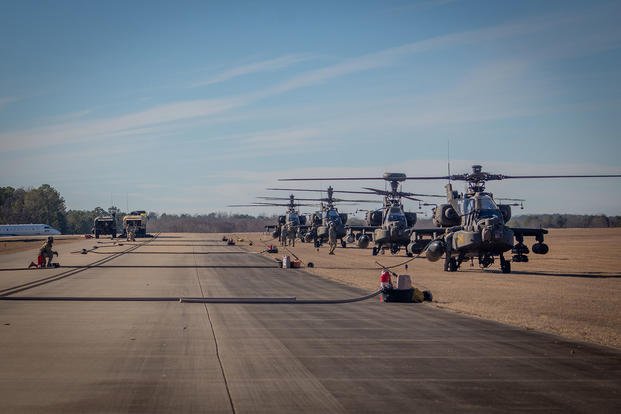
The Army has seen a troubling trend of helicopter crashes, particularly among Apache and Black Hawk helicopters. Last year, the service saw 10 incidents and 14 fatalities.

Now, the service is adding four to six hours worth of training for pilots that focuses on spatial awareness and maintenance issues, though the service was unclear on what that training means in practice.

The move comes after Army aircraft have been grounded twice in the past year -- including once after a crash last April involving two Black Hawks out of Fort Campbell, Kentucky, that killed nine soldiers in one of the deadliest training incidents in the service's history.

The Army National Guard also grounded its aircraft in late February after two of its pilots died in an AH-60 Apache crash in Mississippi. In a prior incident Feb. 12, a National Guard Apache crashed near Salt Lake City, Utah, and both pilots survived.

Service planners did not announce any significant tweaks to training or maintenance after those groundings.

In March, two soldiers were injured when their Apache crashed at Joint Base Lewis-McChord in Washington state during what base officials described as routine training. Then, 48 hours later, two more soldiers were hospitalized when their Apache went down at Fort Carson, Colorado. Two New York Guardsmen died in a UH-72 Lakota in southern Texas while supporting federal border security. A border patrol agent also died.

"We get into aspects of flight where the crew must reinforce how to revert back to knowing where you are and where your aircraft is with respect to the ground. And so it always bears reinforcing any spatial disorientation training," Rugen said.

The service declined to comment on whether Rugen was putting the blame for recent fatalities on the pilots. Most of those notable crashes are still under investigation so it's unclear why the Army is suggesting pilot error has been the cause. Historically, the services have been more hesitant to suggest problems with mechanical issues, aircraft design or fundamental matters with how they train pilots.

The incident rate with Army aviation so far this year is 3.22 mishaps for every 100,000 hours, a significant increase from last year's 1.08 crashes or other notable incidents for every 100,000 hours flown, said Brig. Gen. Jonathan Byrom, who oversees Army safety, at the press conference.

Active-duty aviation units are expected to complete the additional training by May 10. The Guard and reserve have an additional month.
Sale FREE Shipping with Prime


Most Viewed Articles