ANSBACH, BY, GERMANY
04.16.2024
Story by Gerlinde Hoyle
U.S. Army Garrison Ansbach
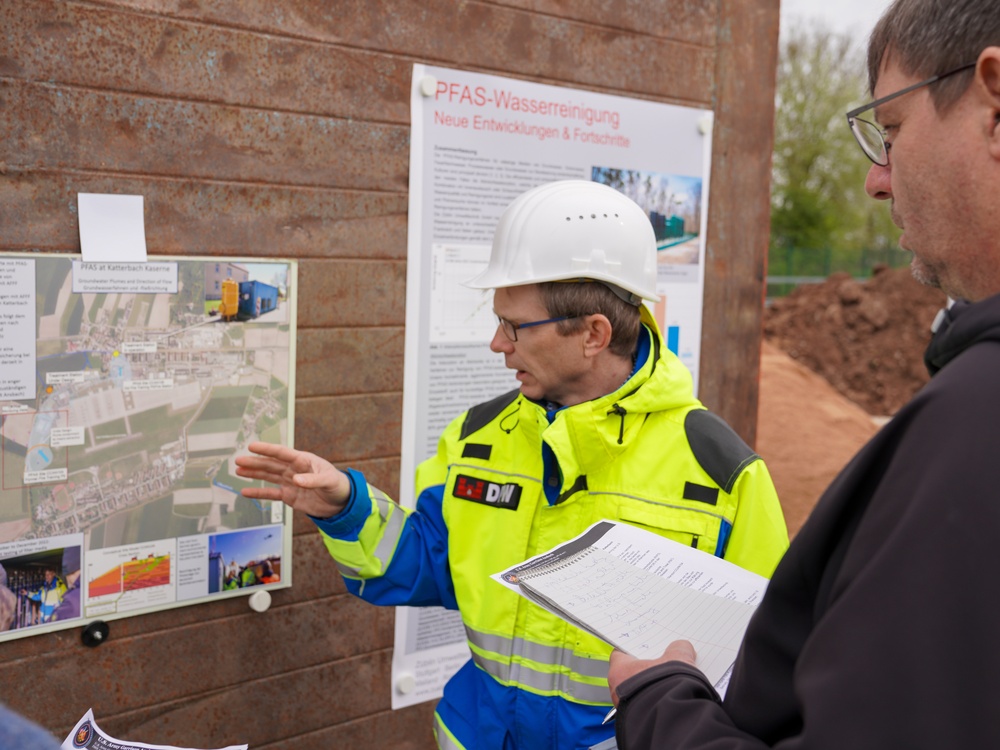
ANSBACH, Germany (April 16, 2024) – On April 11, 2024, United States Army Garrison (USAG) Ansbach invited members of the media to the construction kick-off for the most significant environmental project to date to remove contaminated soil and water from Katterbach Army Airfield near Ansbach. Contamination with per- and polyfluorinated chemicals (PFAS) was detected around the former fire-fighting training area of the US Army about a decade ago and the cleanup is a priority for the garrison and the U.S. Army.
"Protecting our drinking water and being good stewards of our environment is the responsibility of every citizen – regardless of nationality,” said Colonel Aaron Dixon, USAG Ansbach commander. “As American Soldiers, we want to be good citizens no matter where we are stationed – and right now, we are guests here in Germany. It is our responsibility to remain welcome guests. Through proactive measures, we uphold our duty to protect both our mission and the communities we serve.”
What is PFAS?
PFAS stands for per- and polyfluorinated alkyl substances and refers to a group of more than 4,700 chemical substances. They are extremely durable compounds that are water, grease and dirt repellent and are used in many different products such as tableware, outdoor clothing, paper cups, pesticides, and fire-fighting foam. Fire Departments around the world used fire extinguishing foam containing PFAS for decades and these chemicals can still be detected in the soil today. USAG Ansbach stopped the use of Aqueous Film Forming Foam, commonly referred to as AFFF, in firefighting training more than 20 years ago. However, like many civil and municipal airfields worldwide, PFAS remains long after the closure of these facilities.
A major problem for the environment is the extreme persistence of PFAS. The chemicals accumulate very easily in organisms and living beings. The compounds can sometimes spread far via water or lead to large-scale contamination. Humans usually absorb the chemicals into their bodies through food and drinking water.PFAS are considered potentially harmful to health above certain concentrations. They can increase the risk of cancer or lead to other adverse health effects.
"This [groundbreaking] is the first very important step; we will reach the next milestone in October,” said Stephan Haas from the garrison's environmental department at the media event.
“It is a safety measure, but not a final remediation", explained Haas. It will prevent contaminated groundwater from flowing into the surrounding area and contaminating nearby wells and bodies of water.
The Pump and Treat system consists of nine extraction wells, designed to cut off the groundwater plume emanating from the contaminated area along the airfield. The contaminated groundwater - a maximum of 135 cubic meters per day – will be transported via 700-meter-long pipelines to a purification facility, where the PFAS chemicals are filtered out in a multi-stage process using ion exchangers. The filtered and clean water is then discharged into a local creek.
In September 2020, the U.S. Army Corps of Engineers (USACE) awarded a contract for the design for the selected groundwater remediation at a cost of approximately $600,000, which was subsequently completed in July 2023. Two months later, USACE finalized the construction contract, paving the way for the construction start in April, once the ground thawed.
"We understand the frustrations caused by the wait for the PFAS remediation project to commence,” said Dixon. “Each site presents unique challenges, and there's no one-size-fits-all solution. It's imperative that we get it right the first time to ensure the safety of our community and environment. “
The construction of the PFAS Pump and Treat system, including its operation in the first year, will cost around $2 million dollars, financed by Army Environmental Command in San Antonio, Texas, and then onward, an estimated annual operating cost of $260,000. This includes extensive monitoring, which includes not only 21 measuring points within the U.S. Army footprint, but also measuring points within the city of Ansbach and the surrounding area.
Mathias Brenner, head of the City of Ansbach's environmental department, was on hand during the event and emphasized: "We are pleased that the measure is now being implemented. It will be exciting to see the results, because there is simply a risk when you work in the damage center, that pollutants can run off uncontrollably."
It is not yet clear what measures are planned for the main source of contamination, the extinguishing area of the former fire-fighting training area. One course of action, demanded by a local citizens’ initiative, is the excavation of all contaminated soil. Regarding removal of the contaminated soil Haas said, "The feasibility study is in its final stages, but the large-scale implementation is still unclear.”
At the Katterbach airfield, this would involve the potential treatment or storage of around 28,500 cubic meters of highly contaminated soil. But the road ahead is not yet clear. According to one study, only 75 percent of the pollutants can be removed by excavation. This is because over the decades, PFAS particles have seeped into the sandstone layer that begins three meters below the surface.
U.S. Army authorities are aware that, despite its considerable scope, this innovative Pump and Treat system is only another further step in the necessary PFAS remediation in Katterbach. The soil at the source of the damage must be remediated and the installation of further groundwater purification systems are also possible. All measures are being pursued with the necessary professional care and always in close coordination with the responsible German authorities.
“As we move forward, future studies and projects for soil remediation and water treatment will remain a priority, reaffirming our commitment to thorough and effective environmental stewardship,” confirmed Dixon. “As modern society grows in our understanding of what is best for our environment, the United States Army is right there with you. These PFAS remediation projects at the Katterbach Army Airfield are a testament to our commitment to being good stewards and model citizens.”
The U.S. Army Garrison Ansbach military community is located in the Franconian region of Bavaria and is spread across six sites and nine kasernes dispersed around the city of Ansbach and the village of Illesheim. Today, Ansbach is home to the 12th Combat Aviation Brigade, the community's largest tenant unit, as well as the 7th Engineer Brigade, 5th Battalion, 4th Air Defense Artillery Regiment, and 1st Battalion, 57th Air Defense Artillery Regiment. The garrison takes pride in supporting more than 12,000 Soldiers, civilians, family members, and retirees working and living in the Ansbach area.
For more news from U.S. Army Garrison Ansbach, visit: https://www.army.mil/FranconianNews or https://www.facebook.com/usagansbachcommunity/