Friday, January 20, 2017

Firefighters teach jaws of life lessons

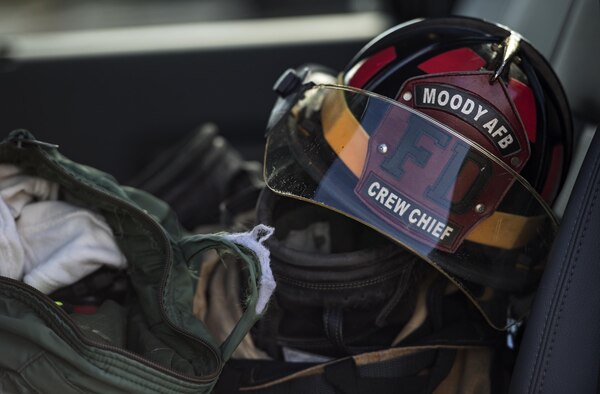
A fire helmet rests on a seat, during Vehicle Extrication training, Jan. 13, 2017, at Moody Air Force Base, Ga. This training was included as part of an Emergency Medical Technician refresher course where students learned about vehicle extrication from Moody’s own firefighters. (U.S. Air Force photo by Airman 1st Class Janiqua P. Robinson)
By Airman 1st Class Janiqua P. Robinson, 23d Wing Public Affairs / Published January 18, 2017

MOODY AIR FORCE BASE, Ga. --
The culmination of a week’s worth of classroom and hands-on training came to a head Friday as students ended their Emergency Medical Technician refresher course by participating in a Vehicle Extrication training, Jan. 13, 2017, here.

Students donned gear and used tools firefighters would use in the field to remove vehicle parts that would free a patient and allow them to be removed from the vehicle. They were instructed by firefighters, who know the importance of teamwork.

“It’s important for us to practice together because we’re going to be working together on scene,” said Tech. Sgt. Andrew Nickeson, 23d Civil Engineer Squadron, NCO in charge of the emergency communications center. “We have to work as a team and there’s no better way [to foster that dynamic] than through training.”

For this training, students wore firefighters bunker gear, which consists of three layers to protect the wearer from debris and extreme temperatures. The first layer prevents abrasive material from getting through the gear. Then the second and third layers provide protection from water and heat during a fire.

While it was important for students to know about the gear and what it’s designed to do, they also needed to know its limitations.

“For vehicle extrication, we wear our gear to protect us from sharp objects,” said Jeremy Valler, 23d CES crew chief. “If we’re cutting out a victim with hydraulic power tools, the bunker gear will stop minor impacts from injuring you, but, you’re not immortal in the bunker gear.”

While the bunker gear provides protection, the knowledge of how the tools work, and what firefighters do on scene for vehicle extrication helps keep everyone safe.

“They need to be knowledgeable about what we’re doing,” said Nickeson. “If they know exactly what we’re doing and why we’re doing it, it’s only going to make it that much safer on scene.”

Safety is the number one concern of first responders. Whether it’s keeping themselves safe, or ensuring the safety of the patients they rescue, they put safety first.

“We have to ensure that we’re all safe,” said Nickeson. “Responder safety is number one because if you get hurt, you can’t help anyone.”
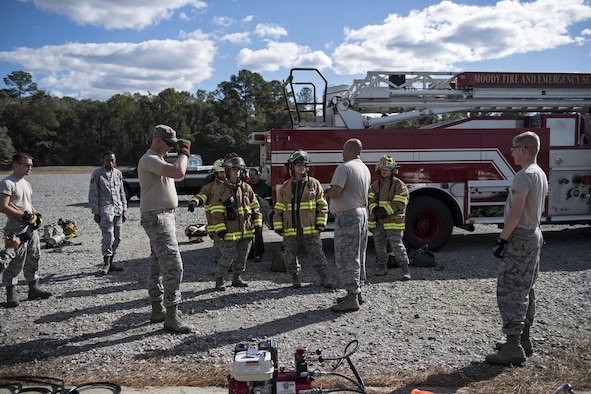
Members of an Emergency Medical Technician refresher course, listen to final instructions, during Vehicle Extrication training, Jan. 13, 2017, at Moody Air Force Base, Ga. The students donned the top half of the protective gear to shield them from any debris during the training. (U.S. Air Force photo by Airman 1st Class Janiqua P. Robinson)

See More Great Pictures

Thursday, January 19, 2017

Mutual Aid: Department supports local communities with fire, ambulance services whenever called

Mutual Aid: Department supports local communities  with fire, ambulance services whenever called
Firefighter/Emergency Medical Technician-Intermediate Hunter Young with the Directorate of Emergency Services Fire Department conducts maintenance tests on a fire truck during operations at the fire department Dec. 19, 2016 at Fort McCoy, Wis. (U.S. Army Photo by Scott T. Sturkol, Public Affairs Office, Fort McCoy)
FORT MCCOY, WI, UNITED STATES
01.18.2017
Story by Scott Sturkol
Fort McCoy Public Affairs Office

In mid-November, Fort McCoy emergency-response personnel with the Directorate of Emergency Services, or DES, Fire Department responded to a two-car collision near Sparta, Wis.

The DES crew that was among several agencies that responded to help provide immediate medical attention to the two drivers in the accident. Such responses outside of Fort McCoy’s borders are possible because of mutual aid and automatic aid agreements the department has with emergency-response agencies in Monroe and La Crosse counties as well as through the Wisconsin Mutual Aid Box-Alarm System, or MABAS.

In 2015, Fort McCoy Fire Department personnel responded to 12 mutual aid or automatic aid requests in local communities, said Fort McCoy Fire Chief David Biondi. In 2016, the department responded to 46 mutual aid/automatic aid requests.

“These responses have involved … structural fires, underwater rescue, auto accidents, and ambulance calls,” Biondi said.

Mutual aid agreements are signed documents that define how and when assistance might be provided between partner agencies, said Assistant Fire Chief Brady Brever with the DES Fire Department. “(Those partners) will then send crews out to help (Fort McCoy) if we ask, and we can respond to help those agencies as well.”

Most of the fire department’s mutual-aid support involves working with Tomah and Sparta fire districts and ambulance services. Jody Allen, ambulance director for Tomah, said the partnership the mutual aid agreement they have with Fort McCoy has worked out great.

“It’s appreciated,” Allen said. “We’re all in it for the same reasons — to help people.”

Brever said Fort McCoy also has an automatic aid agreement with the Oakdale Fire Department. “These agreements are specific,” he said. “If they have a structure fire (for example), we send a fire engine with four firefighters and a command vehicle with an assistant fire chief. And, if we have a structure fire, they send an engine with four firefighters.”

The department’s involvement in MABAS includes more widespread support. Every participating entity has signed the same contract as 750-plus other MABAS agencies, according to the MABAS Wisconsin website, www.mabaswisconsin.com. Participating agencies agree to standards of operation, incident command, minimum, level of equipment staffing, safety, and on-scene terminology.

“We belong to Division 145 and 134 — Monroe and La Crosse counties — in MABAS,” Biondi said. “We also can support MABAS in some areas of Juneau County.”

MABAS agencies are able to work together seamlessly on any emergency scene. All MABAS agencies operate on a common radio frequency and are activated for response through pre-designed “box” cards that each participating agency designs and tailors to meet their local risk needs.

The box cards list specific resources and personnel the department will use to support other fire/emergency response agencies in their MABAS districts.

“An example would be sending a water tanker and crew to support a fire response in La Crosse Country for a specific fire agency,” Brever said. “There’s numerous box cards that are used for each district.”

MABAS also provides mutual aid station coverage to a stricken community when its resources are committed to an incident for an extended period.

Biondi said mutual aid agreements are common throughout the United States and are crucial in providing the support needed in fire and ambulance emergencies.

“It’s not unusual on a large structure fire that you might need 40 or 50 (firefighters),” Biondi said. “To find those numbers, you need to rely on either MABAS or a mutual aid program.”

Brever said the Mutual Aid agreements also help Fort McCoy’s personnel better know the people of other departments.

“I think our (people) have appreciated the mutual aid agreements because this allows them to get out into different communities and do their jobs as well as train,” Brever said.

Building training cooperation and camaraderie with other agencies does help each firefighter and emergency medical technician significantly, Brever said. “More importantly, the cooperation helps us to save lives, help people, and protect property,” he said.

For more information about the DES Fire Department, call 608-388-2508.

For more about this Article and Pictures:

Wednesday, January 18, 2017

Coast Guard rescues 2 from plane crash

Coast Guard rescues 2 from plane crash
A Coast Guard Air Station Kodiak MH-60 Jayhawk helicopter crew transfers two plane crash survivors to emergency medical personnel at Air Station Kodiak, Alaska, Jan. 16, 2016. The Piper Cherokee airplane went down at the mouth of the King Salmon River near Pilot Point with two people aboard. U.S. Coast Guard photo by Lt. John Rauschenberger.

A Coast Guard Air Station Kodiak MH-60 Jayhawk helicopter crew hoist two survivors from a plane crash near Pilot Point, Alaska, Jan. 16, 2017. The survivors were transported to Kodiak for medical treatment. U.S. Coast Guard video.

KODIAK, AK, UNITED STATES
01.16.2017
Courtesy Photo
U.S. Coast Guard District 17 PADET Kodiak

2 Eject at Meridian Naval Air Station

T-45 airplane
SOURCE: NAS Meridian
MERIDIAN, Miss. — Officials at a Mississippi military base say a jet has crashed on a training flight, and that two people on board the plane were able to safely eject near the airfield.

Naval Air Station Meridian said in a statement to The Associated Press that an instructor pilot and a student were both taken to a medical facility for evaluation and were in stable condition Tuesday afternoon.

Authorities said the T-45C Goshawk jet crashed shortly before 2 p.m. Tuesday at the base in eastern Mississippi.

Authorities said the aircraft is assigned to Training Air Wing One, and crashed off the east runway.

Base officials said the jet that crashed is used for intermediate and advanced portions of the Navy/Marine Corps pilot training program for jet carrier aviation and tactical strike missions.

Multi-national Coalition fire training course strengthens team fight against ISIS

Multi-national Coalition fire training course strengthens team fight against ISIS
A 380th Expeditionary Civil Engineer Squadron firefighter drags a hose during a timed firefighter confidence course at an undisclosed location in Southwest Asia, Jan. 16, 2017. Participants completed nine stages during the course including a ladder climb, hose drag, sled pull, hose throw, equipment carry, forcible entry, hotel pack, equipment hoisting, and rescue. (U.S. Air Force photo/Senior Airman Tyler Woodward)
(UNDISCLOSED LOCATION)
01.17.2017
Story by Senior Airman Tyler Woodward
380th Air Expeditionary Wing

SOUTHWEST ASIA—Deployed French and U.S. Air Force firefighters competed in a firefighting confidence course to ensure operations against Da’esh continue safely at an undisclosed location, Jan. 17, 2017.

Firefighters were required to perform ladder climbing, hose dragging, ax swinging, equipment hoisting and rescue carrying during the timed event while donned in personal protection equipment weighing roughly 50-75 pounds.
Chief Master Sgt. Mark, 380th Expeditionary Civil Engineer Squadron Fire Chief, discussed the importance of developing Coalition relationships while in a deployed environment.
“The first time that we meet these guys shouldn’t be at the scene of a crash,” Mark said. “This training instills that sense of confidence that they are doing the same thing we’re doing and we’re doing the same thing they’re doing.”
The 380 ECES designed the course with the intent of strengthening the bonds and relationships between participants.
“It’s all about teamwork,” 380 ECES firefighter Staff Sgt. Jonathan said. “We’re coming together and cheering each other on as we’re doing the obstacles and also this stuff goes hand-in-hand with what we do daily.”
Coalition air power in support of Joint Coalition Task Force-Operation Inherent Resolve has assisted Iraqi Security Forces in the liberation of more than 50% of the territory held by Da’esh since December 2016.
Due to the high volume of sorties flown in support of OIR, firefighters must maintain strong relationships with Coalition partners.
“It’s very important for my guys to develop this relationship and exchange different techniques,” French Air Force Fire Chief Stephan said. “If there were ever a big incident with a French aircraft, I’m sure we would need their [380 ECES firefighters] help; it’s important to know how each of us work.”
Multi-national Coalition fire training course strengthens team fight against ISIS
A 380th Expeditionary Civil Engineer Squadron firefighter climbs a ladder during a timed firefighter confidence course at an undisclosed location in Southwest Asia, Jan. 16, 2017. Fellow firefighters of the 380 ECES supported each member as they progressed through each obstacle. Participants completed nine stages during the course including a ladder climb, hose drag, sled pull, hose throw, equipment carry, forcible entry, hotel pack, equipment hoisting and rescue. (U.S. Air Force photo/Senior Airman Tyler Woodward)

Multi-national Coalition fire training course strengthens team fight against ISIS
A French Air Force firefighter celebrates with U.S. Air Force firefighters after completing a firefighting confidence course at an undisclosed location in Southwest Asia, Jan. 17, 2017. 6 members of the FAF participated in the event. During the course, U.S. and French personnel supported each participant as they progressed through the obstacles. (U.S. Air Force photo/Senior Airman Tyler Woodward)
See more great pictures here:

Most Viewed Articles